
Sales POP - Purveyors of Propserity
6 Deadly Sins of CRM

6 Deadly Sins of CRM

In an ironic twist, the number of solutions to various problems has actually become problematic. The sheer volume of potential solutions to common issues that come up in the sales world has become overwhelming, and it can be difficult to choose the right one. Companies attempt to hunt for the best possible solution, but often times the financial outlay is considerable. When a company eventually does decide to make a purchase, it becomes even more expensive because these solutions require regular, yet costly updates.

Wouldn’t it be beneficial and hassle reducing to have the solution? Like, a CRM that does everything you need? Yes! In order to understand that you’re making the most of your single solution, there are 6 deadly sins to avoid when choosing and implementing a CRM.

Nikolaus Kimla’s ebook, CRM Coming Back from the Dead: CRM in the Digital Revolution explores these deadly CRM sins.
6 Deadly Sins of CRM

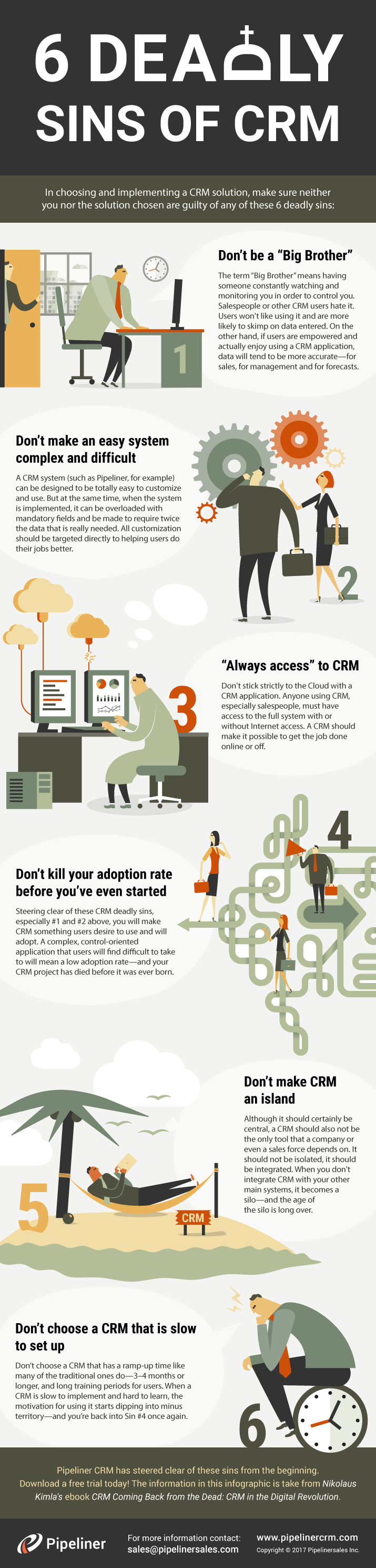
Here are the 6 deadly sins of CRM:

  1. Don’t be a “big brother”: If a CRM software is enjoyable, and the sales manager empowers their sales staff to utilize it, there is less need for monitoring.
  2. Don’t make an easy system complex and difficult: A CRM should be customizable so that it is easy to use. Customization should be targeted to helping users do their jobs better by making things simpler.
  3. “Always access” to CRM: A good CRM should allow for use online or offline.
  4. Don’t kill your adoption rate before you’ve even started: If your CRM is complex and difficult to use, the sales team will be less inclined to utilize it. Keep it simple, and get a better adoption rate.
  5. Don’t make CRM an island: CRM should be integrated into other tools, systems, and protocols that are used by the company. Integrating it ensure that it fits seamlessly into the day to day operations that are already in place.
  6. Don’t choose a CRM that is slow to set up: When a CRM is difficult to use and requires an extensive training period, the motivation to use it declines.

To read more about CRM solutions, check out 4 Reasons Financial Services Needs a Leading-Edge CRM Tool. If you’re ready to integrate an efficient solution with a CRM that avoids the 6 deadly sins, visit Coevera for your free trial.

 

5 Smart Referral Selling Steps

5 Smart Referral Selling Steps

Are you neglecting the crucial step of asking for a referral?

There are a lot of crucial things to do in sales. But, are you missing out on one of the most crucial steps? Asking for referrals is key to getting more business, increasing your revenue, and growing your business.

There are numerous benefits to asking for referrals, aside from getting the increased business. First, you get insight into if your current clients think you’re worthy of being referred or not. A client that refers to their friend or colleague means that they appreciated the work you did for them, and feel like you will bring value to others in their life. Additionally, if you get a referral, you are able to have that client voice your credibility and vouch for you that you will be the best salesperson for the job.

5-Smart-Referral-Selling-Steps

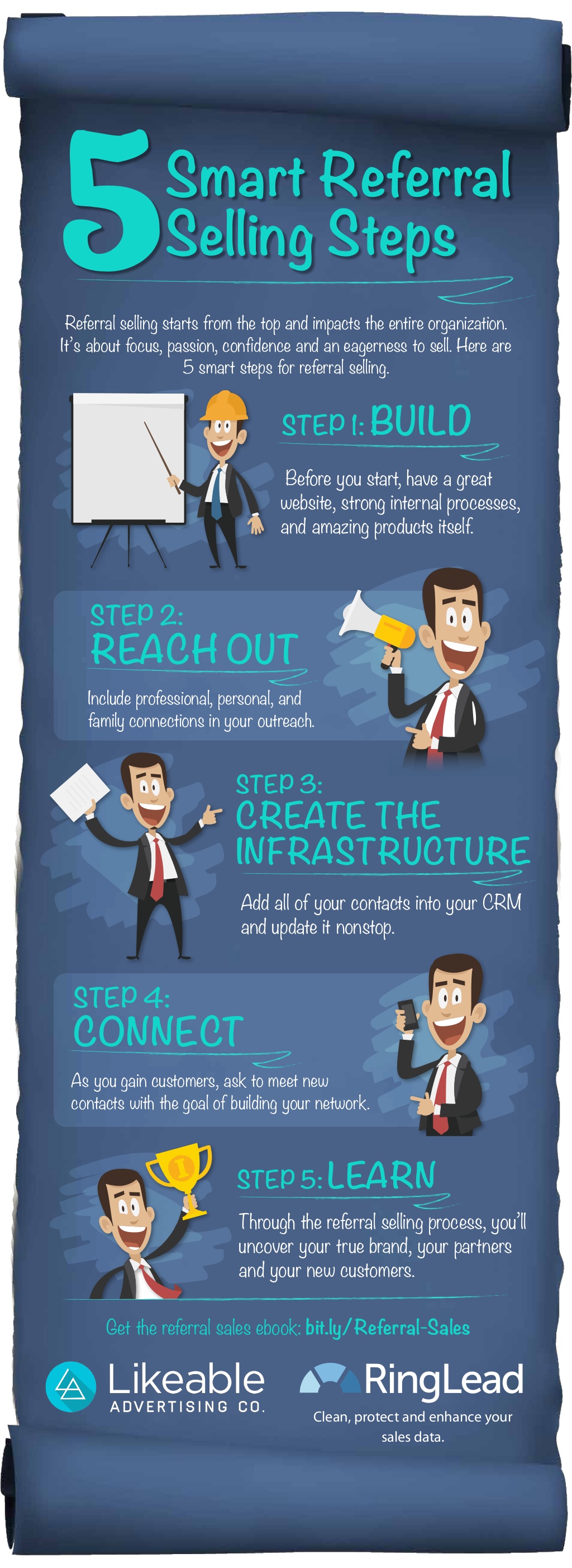
  1. Build: Have a great website, internal processes, and products! You can’t start something without a foundation.
  2. Reach out: Include trusted others in your outreach! The more people who can vouch for you, the better. Plus, you let others do the work for you by asking colleagues, friends, and family to pass your name around.
  3. Create the infrastructure: Add all of your contacts into your CRM. Make sure the software you choose is the best possible. Check out Coevera, and get a free trial to see if it’s the solution for you.
  4. Connect: As you build your business and create new connections, network with those connections! Use who you already know to generate more contacts.
  5. Learn: In the referral selling process, you grow to understand your brand and who you are as a salesperson.

Want to learn more about sales referrals? SalesPOP! has tons of articles to help you get more informed. Check out Your Best Prospecting Tool is Literally Staring You in the Face, and How Can You Get More Qualified Sales Referrals?.

5 Vital Steps of a Sales Process – Infographic

5 Vital Steps of a Sales Process – Infographic

The sales process is so important. It is a vital series of steps followed by salespeople to track an opportunity all the way from lead to a close. You wouldn’t start playing a sport without knowing the rules or the different steps it takes to win. On the same token, it’s not wise to try and sell without executing each step of the sales process. Following these vital steps will help you get your close, turn customers into returning customers, get key referrals, and make more money!

In this infographic, it can be seen that using the Coevera Selling System as a guide, any sales process runs through 5 basic common steps.

Vital Steps of Sales Process an Infographic

  1. Focus: At the beginning of the sales process, play the role of focused investigator. You want to understand the prospect and what their needs are so you can understand how to properly sell to them later in the sales process.
  2. Engage: Engage your prospect! After you’ve done investigating the person or company you are trying to sell to, you can actually reach out and engage the potential customer for a sale.
  3. Convince: At this point in the sales cycle, it is the salesperson’s job to convince the customer that they are the right company to buy from. This is the stage that the sale is ultimately made it.
  4. Close: This is where a new sub-process begins. For the salespeople, this is when they often tend to disengage. However, now that the client is officially a customer, it’s more important than ever to deliver your promises. At this stage, if executed properly, it can be a catalyst for a new sales process with the same clients, just for different products or services.
  5. Cooperate: After the close, hopefully, your customer will move into being an advocate! If your customer liked the services or item you provided, as well as your service as a salesperson, you are more likely to have them be a referral source so that the sales process and continue with referred clients.

To learn more about the sales process, check out the article Transparency in Your Sales Process, and the expert sales interview Accelerators in the Sales Process.

Managing a Social Selling Team – Infographic

Managing a Social Selling Team – Infographic

Social selling has revolutionized the sales world, which has created the necessity of managing a social selling team. In recent years, using social media and other similar platforms to sell has taken off, and it has been difficult to keep up with the trends, especially for sales managers who are already juggling a lot of other responsibilities. Most social selling information is dedicated to helping the salesperson. While this information is necessary and very needed, it can be neglecting of the sales managers.

That’s why John Golden of SalesPOP! and Matt McDarby of USR teamed up to bring you 9 powerful tips and practical advice to ensure that social selling is adopted and managed in the right ways.

Managing a Social Selling Team - Infographic

  1. The sales manager is the greatest revenue multiplier in a sales organization: If the sales manager doesn’t understand social selling, the sales team will struggle to understand it as well.
  2. The sales manager as an agent of social change: The sales manager can introduce the topic and have a hands-on approach to create social change
  3. Use social profiles as a branding opportunity: Customers will be looking at your social media to understand your company and your brand.
  4. Writing too much is the new talking too much: Communicate in brief, yet meaningful statements.
  5. Likes and shares don’t pay the bills: Likes and shares don’t pay the bills, but sales do!
  6. Measuring success: Measure your success, but not at the cost of strategic growth goals.
  7. Patience: Research, listen, and help your prospects with patience and care
  8. Always focus on the buyer: As a sales manager, it’s important to focus on the buyer first
  9. Create a “social sales management action plan”: Don’t go into something new without a game plan!

SalesPOP! has tons of information created specifically for sales managers. We also have an entire audiobook dedicated to the topic of social selling for sales managers.

6 Powerful Steps to becoming a Champion Salesperson

6 Powerful Steps to becoming a Champion Salesperson

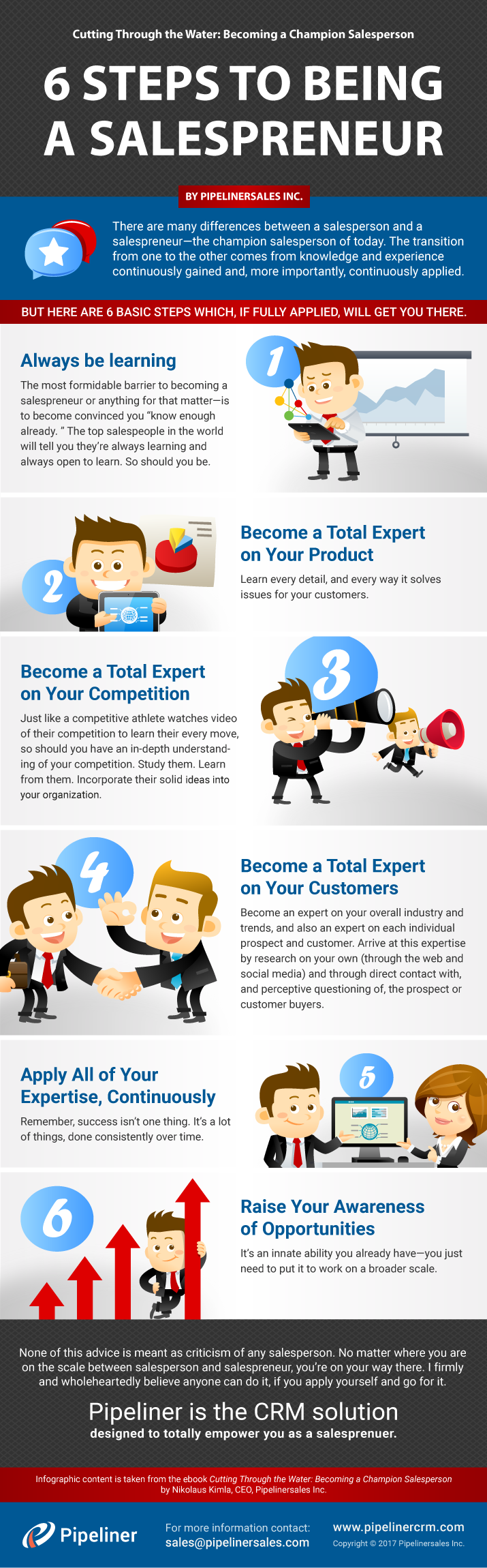
Everyone wants to excel at their jobs, and being a salesperson is no different. A ‘salespreneur’ is the champion salesperson of today, and something that every salesperson should strive to be.

Information for this infographic was sourced from Nikolaus Kimla’s breakthrough ebook, Cutting Through the Water: Becoming a Champion Salesperson. The book highlights 6 key steps to becoming a salespreneur, that have been condensed into this helpful graphic!

Cutting through the Water

  1. Always be learning: The sales field is constantly changing, and it’s important to continue education so that you can take advantage of new advances. Top salespeople make this a priority, and so should you.
  2. Become a total expert on your product: This may seem obvious, but it’s important to know your stuff! Learn every detail, and know how each aspect of the product can solve a problem for your customers.
  3. Become a total expert on your competition: Part of becoming a champion salesperson means understanding how competitors operate. Study them, learn from them, and become a better salesperson because of them.
  4. Become a total expert on your customers: Understanding your industry, as well as your customers, is one of the most important parts of being a salespreneur.
  5. Apply all of your expertise, continuously: Success isn’t one single thing, but rather a lot of different things done consistently!
  6. Raise your awareness of opportunities: Many of us are already scanning for opportunities, but honing in on this awareness and taking advantage of opportunities that come your way will help you take your sales skills to the next level.

For more infographics from Nikolaus Kimla, take a peek at The 6 Deadly Sins of CRM. Be sure to check out the slideshow version of Cutting Through the Water: Becoming a Champion Salesperson. Sales Champion: Confidence Plus Competence! also highlights ways to become a sales champion.

6 Sins of Sales: Who, What, When, Why, Where, hoW

6 Sins of Sales: Who, What, When, Why, Where, hoW

There’s probably a lot of “sins of sales,” certain things that a salesperson should not do under any circumstances. But there’s a few things in particular that make it difficult to succeed in the sales world.
The infographic is based on the ebook of the same name.

These sins are categorized under the 6 W’s: Who, What, When, Why, Where, hoW.

6-Sins-of-Sales

  1. Who: Selling to the wrong buyer. This is a big sin! If you sell to the wrong buyer, any possibility of closing a sale is eliminated. Customers who don’t have a significant enough need, selling to someone who cannot make purchasing decisions, and those who aren’t in the target market, are the wrong buyer.
  2. What: Lack of knowledge. Make sure that you know enough about your customer, the industry, and your product. Don’t be afraid to ask questions!
  3. When: Bad timing. Timing is critical, and when you have bad timing, it can even cost you the sale.
  4. Why: Not learning from winning and losing. If you aren’t learning from your mistakes as a salesperson, you will very quickly fall behind your colleagues and lose profits. Operate on a growth model, where each loss is a chance for growth.
  5. Where: Wrong place at the wrong time. If you don’t understand your buyers’ process or use the wrong tactics at the wrong time, you’re putting your sale at risk.
  6. How: Outdated methods or no methods. If you use a methodology that is not up to date, it simply isn’t worth it. Using old programs that do not help you keep up with today’s fast-paced world are not worthy of your time.

There are a lot of sins in the business world, including 6 Deadly Sins of CRM. This correlates directly with sin six, “how.” If your CRM system is out of date and not helping you solve problems or meet your needs as a company, you are shorting yourself valuable time and profits.

6 Ways the Salesperson Can Optimize Customer Engagement

6 Ways the Salesperson Can Optimize Customer Engagement

Accountability is the new sales buzzword

It can be difficult to grab the attention of customers. Especially in the era of technology, there is more information than ever available to consumers. This is a frustrating situation, both for salespeople and consumers alike. The internet is flooded with information that doesn’t always exceed quality expectations. This can be mislead to customers, who are frustrated when they aren’t able to get their needs met. This is also frustrating to salespeople, who genuinely have good products and want people to use them, but struggle to stand out in the noise of the lackluster competitors.

6-ways-salesperson-can-optimize-customer-engagement

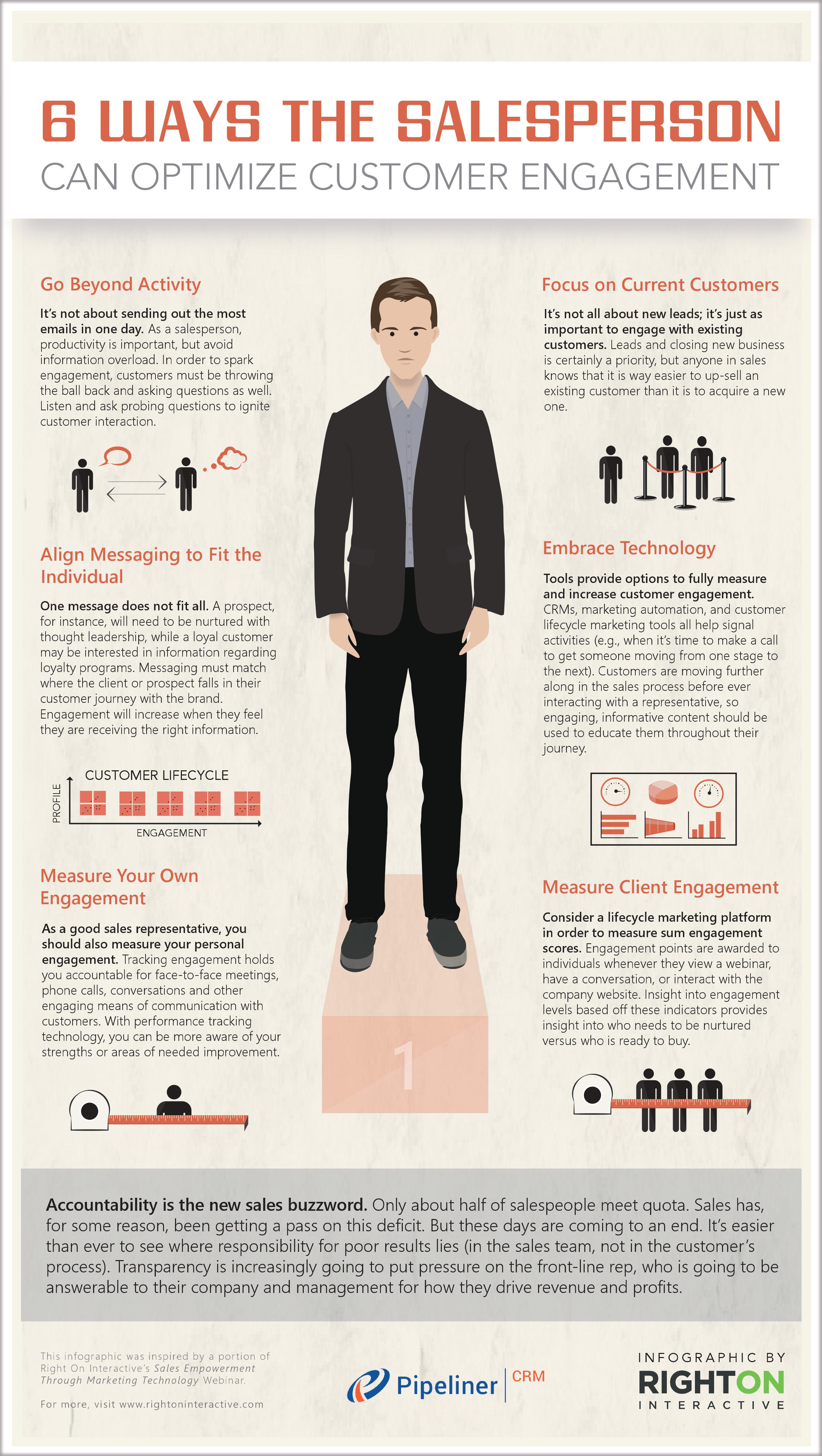
In order to optimize customer engagement, there are 6 key steps to follow.

  1. Go Beyond Activity: It’s not always about getting the most done. Productivity is certainly important, but it’s crucial that quality work is completed and real connections are made.
  2. Focus on Current Customers: Growing your business doesn’t always mean growing your customer base. You can engage with existing customers, as opposed to acquiring new ones, in order to grow your business and optimize customer engagement with the clients that already know, trust, and have a relationship with you.
  3. Align Messaging to Fit the Individual: One message does not fit all. It is not always beneficial to send out mass messages, or generic emails. Instead, use what you know about the individual to tailor their messages.
  4. Embrace Technology: The tools are out there, so use them! If you’re not taking advantage of the programs designed to help you, you’re not being as effective at optimizing customer engagement as you could be.
  5. Measure Your Own Engagement: To be as successful as possible, measure your own personal engagement!
  6. Measure Client Engagement: Understanding your client and their willingness to engage with you can help you manage your client’s engagement with you.

If you’re interested in learning more about improving your customer engagement, SalesPOP! is here to help with articles and key information about pulling in more customers. Articles like Developing Deeper Customer Engagements in the Digital Age, and What Are Your Customers Saying? will help you learn more.

7 Reasons Why Sales and Marketing Alignment Pays Off

7 Reasons Why Sales and Marketing Alignment Pays Off

Sales and Marketing Alignment

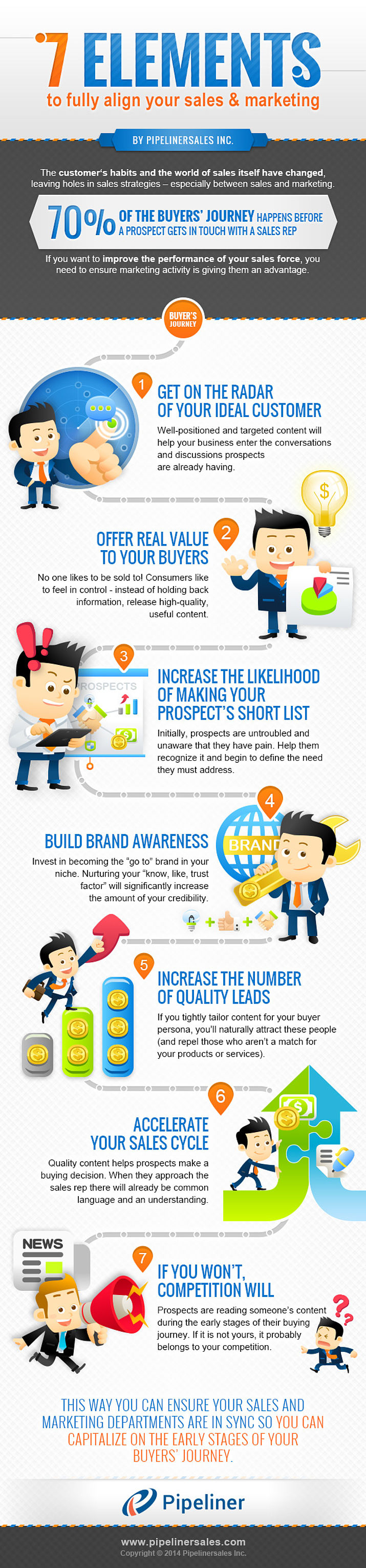
Sales and Marketing have long struggled to align in a cohesive way. These two teams are both very different, but also very necessary. When they are disjointed or do not collaborate, huge problems can ensure that will end up costing you customers and losing the company revenue. 70% of the buyer’s journey takes place before the customer ever speaks to a salesperson. Therefore, it’s especially crucial during the early stages of your customer’s buyers’ cycle, that the sales and marketing team provide a united front to consumers.

Here are seven reasons why sales and marketing alignment pays.

7-Reasons-Why-Sales-and-Marketing-Pays-Off

To help you understand how to better unify these two teams, SalesPOP! has composed 7 Reasons Why Sales and Marketing Alignment Pays Off.

  1. Get on the radar of your ideal customer: Make sure the people seeing your content are the right ones! Position things correctly to ensure that it fits seamlessly into what your idea customers are already looking at.
  2. Offer real value to your buyers: Use high quality, useful content and deliver on your promises.
  3. Increase the likelihood of making your prospect’s short list: In order to do this, help clients understand their problems, and how your product or service can be the solution.
  4. Build brand awareness: Do what you can to make your company the “go to.”
  5. Increase the number of quality leads: Tailor content for your buyer persona, and attract more of your ideal customer.
  6. Accelerate your sales cycle: Creating quality content will help prospects research quickly, and make decisions faster.
  7. If you won’t, your competition will: Potential prospects searching for new information on what product to buy will either read yours, or they will be reading your competitions. Make sure they are reading yours.

SalesPOP! has a whole topic dedicated to the alignment of sales and marketing. For more information on aligning these two teams, check out one of the numerous articles, including Sales and Marketing (Finally) Working Together, and Sales and Marketing: What They Both Need to Learn.

This website uses cookies. By continuing to use this website you are giving consent to cookies being used. For information on cookies and how you can disable them, visit our privacy and cookie policy.