

Sales POP - Purveyors of Propserity
10 “Get Dirty” Rules for Sales Success

10 “Get Dirty” Rules for Sales Success

Embrace the Work, and Don’t Be Afraid to Get Dirty!

Achievement is a messy affair, and if you are NOT prepared to get dirty, chances are you won’t reach your desired destination. Success is not always the elegant result of a formula but requires the sometimes messy route to get to where you plan.

But what exactly does it mean to get dirty for sales success? Roy Osing, the author of the BE DiFFERENT or be dead Book Series, explains how with these 10 key tips.

10-rules-for-sales-success

  1. Make fast decisions: Pondering and over-analyzing doesn’t usually lead to sales success. Take the amount of data that you have, and make a decision. Don’t use valuable resources and waste time by over complicating the route to a decision.
  2. Have a Plan B: Let’s be honest, Plan A doesn’t usually work out. Have a backup plan ready to go, and don’t be afraid to use it!
  3. Embrace Imperfection: There is no such thing as a perfect solution. Imperfections will always exist, and embracing them will lead you to quicker success.
  4. Do it. Try it. Fix it.: Keep your feet moving, don’t lag between decisions.
  5. Align yourself with doers: Let others who are passionate about things be contagious! Pick up their passion, and take on their energy.
  6. Work outside your comfort zone: Not uncomfortable? You’re playing it too safe!
  7. Bend the rules: If you get to a point where a rule is less helpful than helpful, bend it!
  8. Do what needs to be done: Your job description is just a guide. Be the person who won’t let anything stand in their way.
  9. Avoid multitasking: Be wary of long, lengthy lists, and tackling too many things at once.
  10. Don’t be afraid to make mistakes: Make mistakes. Those who follow the growth model, and learn from their mistakes, achieve greater sales success.

If you want to succeed, take a look at your hands. If they’re dirty, you’re on the right path! Take a look at For Sales Success Tell The Truth, and Sales Success in 2018.

1-to-Many with Any—Connect Your Customers and Accounts in Multiple Ways

1-to-Many with Any—Connect Your Customers and Accounts in Multiple Ways

People First Approach!

Coevera gives you the ability to easily assign multiple contacts to multiple accounts, making things more streamlined and easier than ever. We’ve talked a lot about the importance of having a good sales pipeline software here at SalesPOP!, and we back Coevera as the top of the line, state of the art, best CRM software for Sales and the coevera process.

The software is ever evolving and changing, just as the sales world is ever evolving and changing. Coevera aims to create a software that keeps up with these changes, helping you navigate through this sometimes confusing process by creating the most up to date tools. As part of this mission to stay abreast with sales trends, Coevera has added a new feature that will allow salespeople to adapt to new internal processes, channels, and systems, and ultimately to put your customer or prospect at the center. Coevera has turned the classic Account-to-Contacts model on its head. We call it “1-to-Many with Any.”

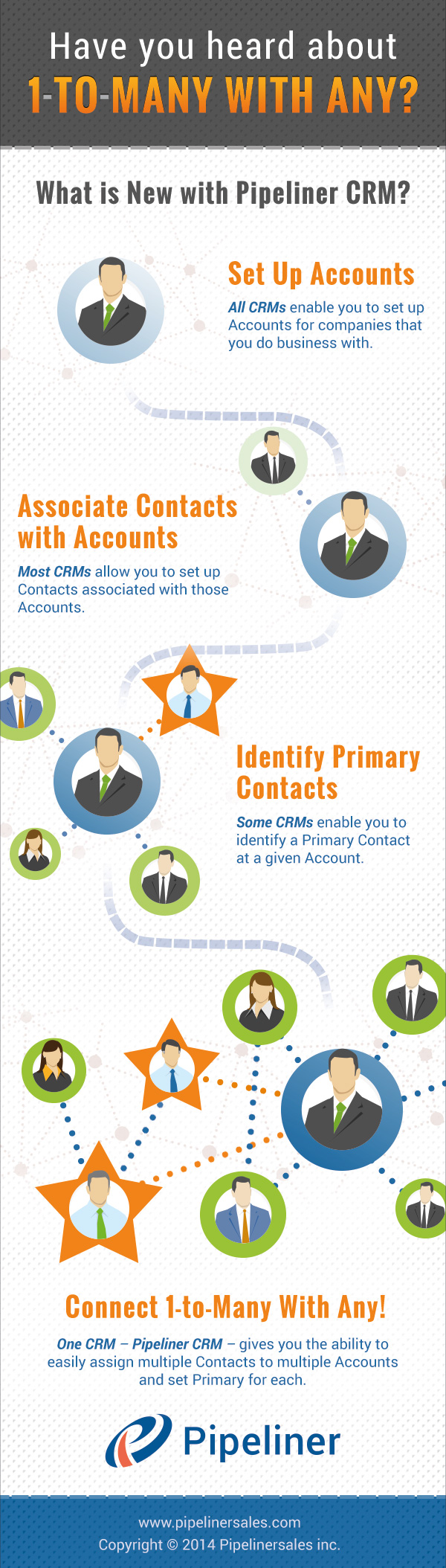
Infographic: 1-to-Many-with-Any

So what else is new with Coevera?

  1. You can now set up accounts: All CRMs enable you to set up accounts that you do business with.
  2. Associate contacts with accounts: Most CRMs allow you to set up contacts associated with those accounts.
  3. Identify primary contacts: Some CRMs enable you to identify a primary contact at a given account.
  4. Connect 1 to many with any! Only ONE CRM, Coevera, gives you the ability to easily assign multiple contacts to multiple accounts and set primary for each.
5 Crucial Sales Process Steps Explained

5 Crucial Sales Process Steps Explained

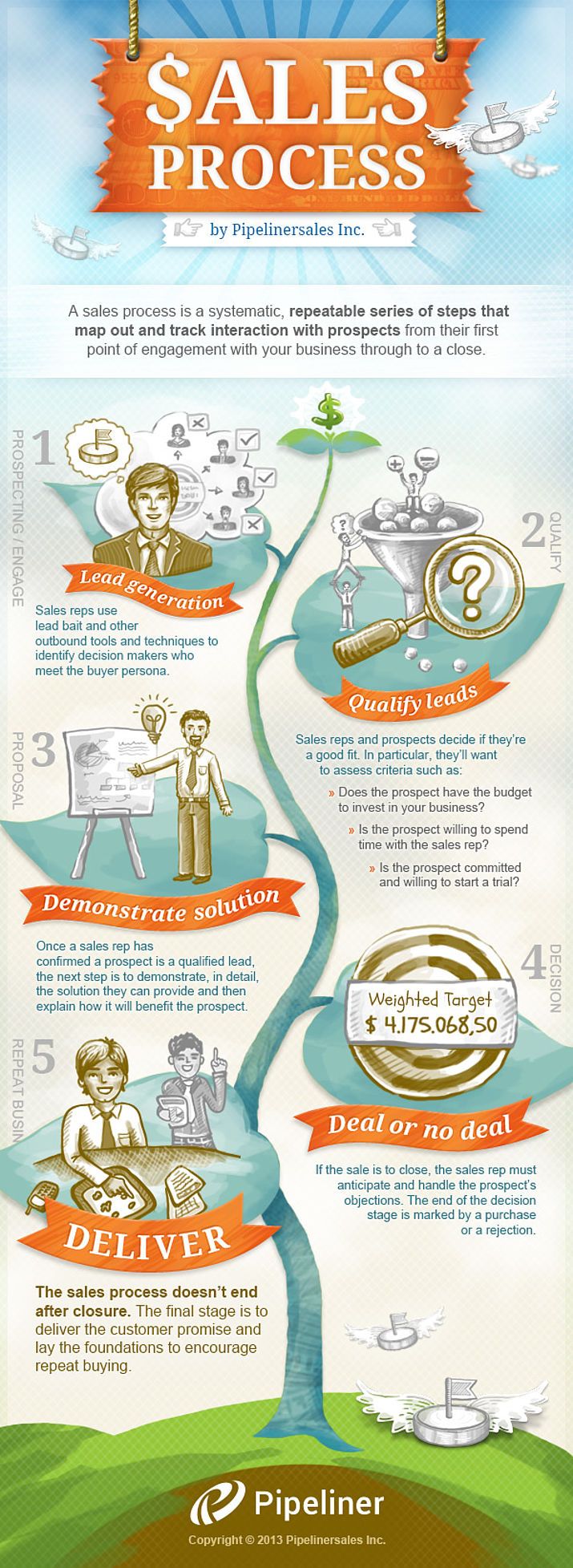
A sales process is a systematic, repeatable series of steps that map out and track interaction with prospects from their first point of engagement with your business through to a close.

Sales Process Steps – What Are They?

Easily master your sales process and generate more revenue using these 5 steps:

  1. Lead Generation (Outbound for Sales Reps)
  2. Qualify Leads (Budget, Capacity, Timing)
  3. Demonstrate Value (Translate into Prospect Needs, Wants, Desires)
  4. Guide Prospect Understanding (Manage Objections, Frame Thinking)
  5. Deliver and Support (Customer Satisfaction!)

Sales Process Steps – Explained

A standardized sales process steps outline not only the main sales steps but also the tasks to be accomplished successfully at each stage – which are absolutely necessary for effective sales pipeline management. Leverage these steps in the sales process to increase win probability, influence customer deal size, and speed pipeline velocity.5 Basic Sales Process Steps

  1. Lead Generation: Master salespeople use lead bait and other outbound tools to perfect their sales process.
  2. Qualify Leads: Sales reps and other prospective customers want to make sure that you’re a good fit for them. Instead of spending time working on a lead that is impossible to win, qualify your leads beforehand so you don’t waste time.
  3. Demonstrate Solution: Once a sales rep knows the lead is qualified, it’s important to demonstrate to the potential customer that you can help them solve their problems, or implement helpful solutions.
  4. Deal or no deal: The sales rep must be able to anticipate and respond to the prospect’s objections, and be prepared to handle a “no.”
  5. Deliver!: The sales process doesn’t end with a signature. The final stage of the sales process is to actually deliver on the promises that you made and follow through on what was said in the first steps of the sales process.

To learn more about the sales process, check out this SalesPOP! content: Accelerators in the Sales Process, Transparency in Your Sales Process, and How to Setup Your Sales Process to Get More Sales.

5 Reasons You Need a Sales Management Tool

5 Reasons You Need a Sales Management Tool

Sales Management Tool

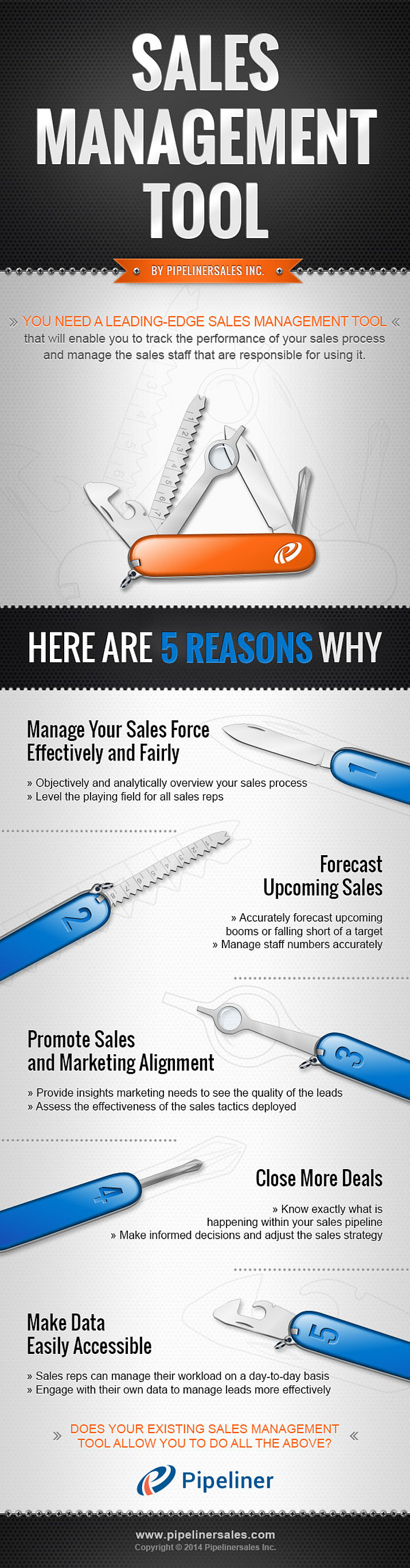
The right sales management tool will enable you to track the performance of your sales process and manage the staff that are responsible for using it. It is absolutely imperative that you utilize a sales management tool if you want to be successful as a company and make the most of the journey through each sales process. Trying to be a sales manager without having a sales management tool is a little like trying to row a canoe without an order. You won’t get very far, or be very successful.

Sales Management Tool

SalesPOP! has generated five reasons why you need a leading edge sales management tool.

  1. Manage your sales force effectively and fairly: Use your CRM to objectively and analytically manage things, and level the playing field for all sales reps
  2. Forecast upcoming sales: Who doesn’t want to be able to tell the future? Use your CRM to forecast upcoming sales
  3. Promote sales and marketing alignment: Sales and marketing have long struggled to align in a cohesive and integrated way. Use your CRM to help ease both teams into a sales and marketing alignment.
  4. Close more deals: Closing deals is the ultimate goal. There’s a tool out there that will help you close deals in the quickest and most efficient way possible, so use it!
  5. Make data easily accessible: Keep everything in one place. You don’t need a myriad of different apps and programs to do what you need, all of your data is in one easily accessible spot.

Coevera strives to be the leading edge in CRM technology and can help you all five things listed above, and more. Check out the website to download your free trial and understand all of the things it can do for you. Sales Management Through Coevera is a great blog article written by Coevera CEO Nikolaus Kimla that discusses the vital parts of sales management utilizing Coevera.Get your free trial of Coevera now.

Coevera Instant Overview

Coevera Instant Overview

If you’re in the sales world, you probably already understand how important it is to have a CRM software. There’s a lot of different options available, and each of them has their own set of unique features. Coevera is a top of the cline program that will help you endlessly, solving problems you didn’t even realize you had. It will make you more efficient, more productive, and help keep you organized, with everything you need in one place.

We’ve laid out a visual infographic to showcase the unique features of Coevera. Take a look, and get to know the product. If you’re interested, get your free trial of Coevera now.

Coevera Overview

  1. We visualize everything: Coevera has a visual, intuitive interface. It makes everything really easy to use, and you won’t be searching everywhere for that one button. You can see things like one-click reports, comprehensive charts, pipeline bubble chart, sales task board, contacts, accounts, and more.
  2. We put efficiency and productivity first: Coevera has a hybrid cloud model, so it’s always available, online or offline. Sales Managers can stay productive and focused no matter where they are. Plus you can access extra tools like the mobile app, configure actions and activities, manage multiple pipelines, and get important alerts and reminders.
  3. We provide the best value for the money: Pipeline services can be so expensive. They are great tools, but if they’re too expensive, and you’re not utilizing all of the features, it can be a waste of money. Coevera gives you everything you need, and more, with a low license cost. Plus, there’s tons of free stuff, like free customer support, free how-to videos, a free sales reference library, and more.
  4. We work great with others: Coevera is very integrated, and you can connect many other applications so that everything is in one spot. Applications such as Gmail, Outlook, Google, Office, and more.

To learn more about Coevera features!  Get your free trial of Coevera now.

How to Generate Sales Leads at Trade Shows

How to Generate Sales Leads at Trade Shows

Lead Generation Techniques for Trade Shows and Exhibitions

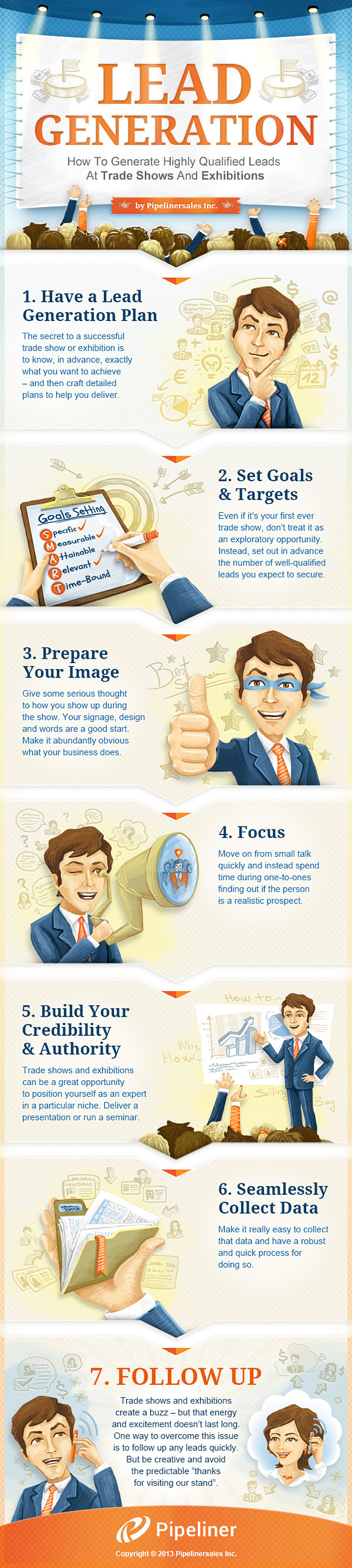
The secret to a successful trade show or exhibition is to know exactly what you want to achieve. If lead generation is your main goal for attending a trade show, we have some key tips to help you generate as many leads as possible.

Lead generation is the act of stimulating interest amongst your target audience for a particular product or service you are selling. Trade shows, exhibitions or conferences are places you can collect a pool of contact details of people who are potentially interested in your product.

Lead Generation

There are 7 lead generation key tips:

  1. Have a lead generation plan: Don’t go in blind! Know in advance what you want to achieve and then create a game plan so you know how to make the most of the event.
  2. Set goals and targets: Even if it’s your first trade show, don’t approach the opportunity as simply exploratory. Set goals, and go after them!
  3. Prepare your image: Give some serious thought into how you will be presenting yourself. You want to make a good first impression and create an image that is on brand with how you sell and what you’re selling.
  4. Focus: Small talk is great for rapport building, but when you’re at a tradeshow with a lot of people to talk to and a short amount of time to do it in, transition quickly from small talk to a focused conversation.
  5. Build your credibility and authority: You want to make sure you demonstrate that you are capable and, credible, and an authority on what you are selling. People aren’t interested in buying from someone who doesn’t really know what they’re talking about.
  6. Seamlessly collect data: Make it very easy to collect data, and have a plan in process for how you plan to organize it.
  7. Follow up: Trade shows are a buzz of excitement, and those in attendance meet a lot of new people! Make sure to follow up, and be creative enough to help potential customers remember you.


4 Pitfalls To Avoid When Measuring Sales Pipeline

4 Pitfalls To Avoid When Measuring Sales Pipeline

Sales Pipeline Pitfalls

Once you build your sales pipeline, you can start to measure its performance. The figures you generate will provide you with the clarity that you need to make better decisions and ensure smarter execution of your ideas. If this gets neglected, it will have many negative consequences that could include a lower closing percentage and lost revenue. Considering what’s at stake, it’s important to ensure you’re getting the most benefit from your sales pipeline measurement. But how can you actually do this?

4 Pifalls to Avoid when Measuring Sales Pipeline

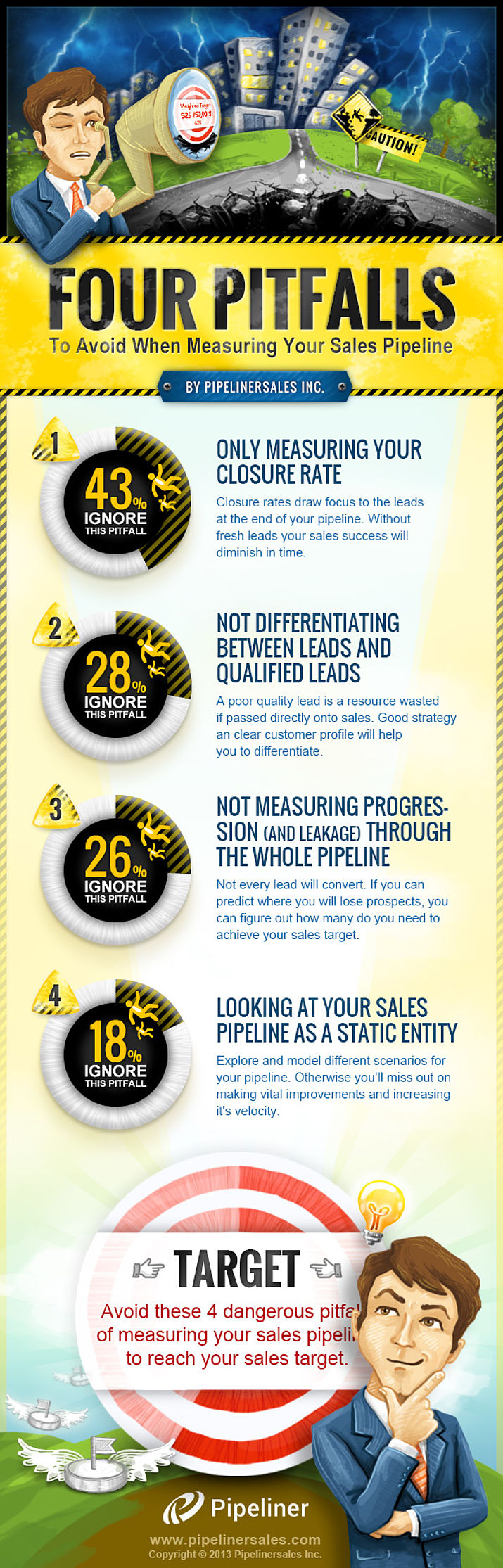
A good starting point is to avoid these four common sales pipeline pitfalls:

  1. Only measuring your closing rate: 43% of salespeople only measure their closing rate! The close is the ultimate goal, but it’s not the only goal. Understand other crucial measurements in order to make the most of your pipeline software and get the most information possible.
  2. Not differentiating between leads and qualified leads: Don’t be one of the 28% of people who do this. A poor lead means that you are selling to someone who isn’t in your ideal customer market, and will likely not end up benefiting from your services or end up buying your product.
  3. Not measuring progression (and leakage) through the whole pipeline: Look at the pipeline as a whole. 26% of people neglect to do this crucial step, and they lose revenue and don’t understand all the information as a result.
  4. Looking at your sales pipeline as a static entity: A pipeline isn’t static. It’s constantly changing, moving, and evolving. Be sure to keep up with it, unlike the 18% of people who ignore this pitfall.

Check out articles such as Sales Pipeline Revealed, and the ebook Pipeline Measurement and Sales Success. If you’re looking for a great tool to measure your sales pipeline, check out Coevera.

The Difference Between Risk-Scenario Probability and Forecasting

The Difference Between Risk-Scenario Probability and Forecasting

This infographic accompanies a blog post – Strengthen Your Sales Forecast with Risk Scenarios (Not Probability) by Frank Donny of Marseli. Frank knows his stuff. After all, he is the creator of the Accurate Sales Forecasting App. He asserts that probability is not the right way to go when you are looking for the most accurate sales forecast. Probability and weighing just aren’t adequate on the front line.

The infographic illustrates:

  • The four risk scenario categories
  • The group process: Collect, Review, Meet
  • Meeting outcomes and expectations

Download this actionable infographic and learn the process, step by step, that will give you the most accurate insights into your sales forecast, in the most simple and intuitive manner possible.

Put it on your wall…share it…admire it!

Power of Risk-Scenario Forecasting

Let’s take a closer look at the four risk scenario categories. These include:

  1. Not applicable: When there is no risk scenario assigned, this task is unlikely to be closeable in that forecast period.
  2. Committed: This is the lowest amount of revenue expected for the time period. Calculate this by adding the revenue that you’ve already won, with the deals that you’ve gotten a verbal go ahead.
  3. Likely: This is everything in the committed category, plus a few other deals that are close to closing, and are likely to be completed before the end of the time period.
  4. Best case: This category is everything in the committed category, plus the deals that need a pretty significant amount of time to close.

Use these formulas to create a solid forecast. You can do this using:
<0l>

  • Collect: Collect possible scenarios from educated others
  • Review: Use the “four rights,” to understand who to engage
  • Meet: Discuss with your colleagues

Download this actionable infographic for the most simple and intuitive way to learn the process. It will guide you, step by step, to the most accurate insights into your sales forecast.

This website uses cookies. By continuing to use this website you are giving consent to cookies being used. For information on cookies and how you can disable them, visit our privacy and cookie policy.