

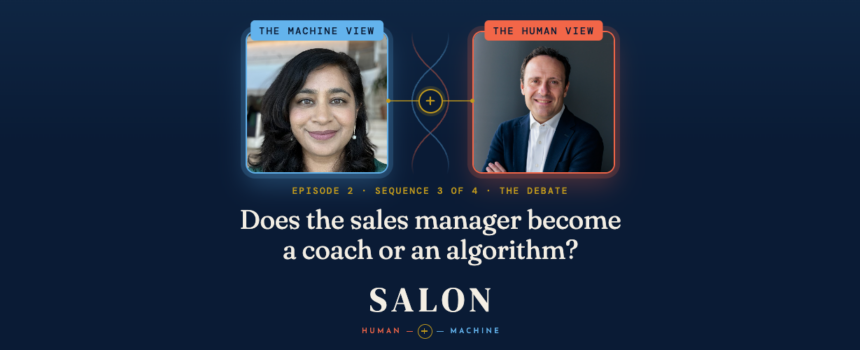
Neha Gupta, Founder & CEO, Breakthrough AI • Andrea Petrone, CEO Advisor, Keynote Speaker, Author, Performance Coach and Consultant
| Episode | Salon #2 · Part 3 of 4: The Debate |
| Debate Question | Does the sales manager become a coach or an algorithm? |
| Speakers | Neha Gupta, Founder & CEO, Breakthrough AI (machine view); Andrea Petrone, CEO Advisor, Keynote Speaker, Author, Performance Coach and Consultant (human view) |
| Websites | joinbreakthrough.ai | Andrea Petrone on LinkedIn |
| Full Episode | Watch Salon #2 | Listen to the Salon #2 podcast |
Can an AI Sales Coach Tell You What You Don’t Want to Hear?
If you have ever asked a chatbot to review your pitch, you may know the feeling. Great idea. Strong opening. You’re right on track. It is pleasant to hear, and almost no help to a rep getting ready for a difficult call.
That was the first question when the two sides of Salon #2 turned to each other. If AI is going to coach salespeople, can it be honest with them? And even if it can, can it understand what is really going on in a sales conversation?
The flattery problem
Andrea Petrone, who argued the human side, raised it directly. “My experience with AI, in the way our AI has been created so far, is actually AI is pleasing.” Even when he asks for unbiased feedback, “it does maybe once or twice, but then at some point it goes back to the pleasing.” He had heard one explanation: a tool that annoys its users risks losing them, so it is built to keep them happy.
Neha Gupta of Breakthrough AI, who argued the machine side, did not disagree. With off-the-shelf tools, she said, “almost always it just tells you, ‘Oh yeah, you’re right.'” For practice, that is worse than useless. A generic chatbot in a role play “is going to actually make you think that you’re very good at something when you’re not actually that good at it, because it just agrees with you.”
Building a buyer that doesn’t back down
Gupta’s answer is that an AI sales coach has to be built for the job. She says Breakthrough AI spent over a year fine-tuning a model so it would not cave. It uses 11 buyer personas, from skeptical to frustrated. They can soften if the rep says the right things, but they’re “not going to just give in and say, ‘Okay, that’s fine. I agree with whatever you say.'” Reps also face the same scenario with different personalities, so that when they meet a dismissive or angry buyer for real, they can think, “I’ve seen this type of personality.”
The lesson for any sales team is simple: a general-purpose chatbot and a practice tool are not the same thing. One tends to agree with you. The other has to be designed to push back.
Can a machine read context?
Gupta then put Petrone’s own argument back to him. With enough context built in, she said, an AI role play partner can recognize when a rep starts to shift the conversation, and shift with them. Had he seen that?
Petrone agreed that “the more you give, the better you get.” But for him, “shifting context for me is a human condition.” Context becomes clear during a live conversation, and AI usually arrives after the fact, with a read that is right only “at high level.” His example: a client says they can’t invest because they’re downsizing. A good rep can help that client see the decision differently, in the moment. AI, he argued, “doesn’t always listen for the context; it listens for what you tell them.”
Where they meet: listening is a skill
Gupta’s reply moved the debate forward. She agreed that you have to really listen to catch context. But many reps can’t yet, even in a live conversation, because the basics take all their attention. “I think most people miss context honestly because they’re all in their heads and trying to figure out what to say.”
That is where she sees AI practice helping. Its feedback is blunt: “You’re speaking too much. You’re not asking enough questions.” Once asking questions and listening become habits, a rep has room to actually hear the customer. In other words, practice with a machine may be what makes the human skill possible.
What this means for sales managers
- Is the AI tool your reps use built to push back, or to agree with them?
- Do your reps practice against difficult buyers, or only friendly ones?
- When a rep misses the context, is it a judgment problem, or are they too busy thinking about what to say?
By the end of the exchange, both sides agreed on one thing: as Gupta put it, “context is huge.” They still disagree on how much of it a machine can ever see. In Part 4, Nikolaus Kimla brings the two views together.
Pull Quotes
Shifting context for me is a human condition.
— Andrea Petrone
It’s going to actually make you think that you’re very good at something when you’re not actually that good at it.
— Neha Gupta
It doesn’t always listen for the context; it listens for what you tell them.
— Andrea Petrone
The Debate in Numbers
| Number | Detail |
|---|---|
| Over a year | Time Breakthrough AI spent fine-tuning a model so it would not just agree with the rep, according to Neha Gupta |
| 11 | Buyer personas in Breakthrough AI’s role plays, from skeptical to frustrated |
About the Facilitator
Nikolaus Kimla, founder of Sales POP! and CEO of Coevera, leads every Salon debate. Rather than interviewing the speakers, he gives each side room to make its case, then brings the two views together at the end of the episode.
Previously in Salon #2: Part 1, the machine view | Part 2, the human view
Next in Salon #2: Part 4, Nikolaus Kimla brings the two views together.
Watch the full debate: Salon #2: Does the Sales Manager Become a Coach or an Algorithm?
Related Resources
- Learn about Breakthrough AI’s AI role play for sales teams
- Connect with Andrea Petrone, author of Reinvention at the Top
- All Salon episodes: salespop.net/media/salon/
- Sales POP! Podcast: salespop.net/media/podcast/
- Coevera: coevera.com