

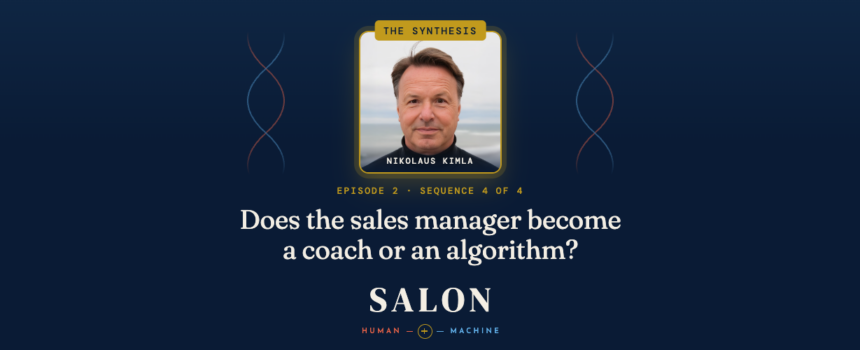
Facilitator Nikolaus Kimla with Neha Gupta, Breakthrough AI, and Andrea Petrone
| Episode | Salon #2 · Part 4 of 4: The Synthesis |
| Debate Question | Does the sales manager become a coach or an algorithm? |
| Speakers | Facilitator Nikolaus Kimla, founder of Sales POP! and CEO of Coevera, with Neha Gupta, Founder & CEO, Breakthrough AI (machine view) and Andrea Petrone, CEO Advisor, Keynote Speaker, Author, Performance Coach and Consultant (human view) |
| Websites | joinbreakthrough.ai | Andrea Petrone on LinkedIn |
| Full Episode | Watch Salon #2 | Listen to the Salon #2 podcast |
From Sales Manager to Sales Leader: What the Machine Can’t Do
Sales managers now have more data than ever: forecasts, pipeline dashboards, AI scores on every call. That raises two uncomfortable questions. If a machine can do so much of the managing, what is left for the manager? And when the machine gets it wrong, who answers for it?
Those were the questions Nikolaus Kimla, founder of Sales POP! and CEO of Coevera, put to both sides at the end of Salon #2, before bringing the two views together.
Who is accountable when the AI is wrong?
More and more sales management depends on forecasting tools, Kimla pointed out. So what happens when the forecast is wrong? Neha Gupta of Breakthrough AI, who argued the machine side, answered from her own field, AI coaching: “I think this is why I don’t think the sales manager job is going away.”
Her view is that AI should produce the evidence and people should make the calls. After a team works through AI role plays, the data shows who has improved, who hasn’t, who could coach their peers and exactly where others struggle. Then the manager steps in. “I know that’s the side I’m supposed to argue, but I don’t actually believe that AI should do every piece of it,” she said. Humans “should step in and double-check things.”
Take away the grunt work, not the job
The deeper problem, Gupta argued, is time. Managers “get so bogged down in all of the day-to-day work as a sales manager that there’s no room to actually provide that real strategic advice.” The point of the technology is to “remove some of that grunt work,” so a manager can actually lead.
The hardest part is letting go
Kimla then asked Andrea Petrone, who argued the human side, what a sales manager must learn in the next two years to stay relevant. His answer was about identity, not tools. Managers “need to start becoming a facilitator of the technology, enabling the technology for their own people,” and let go of the urge to control every conversation and every number.
He did not pretend that is easy. Sales managers came up through the field. They were close to customers, and they loved it. Asking them to step back, use AI as intelligence for strategy, and lead a mix of human reps and AI agents is “a radical shift.” In his words: “I don’t know how many sales managers are up for that challenge.”
Management for the machine, leadership for the manager
Kimla’s synthesis started with the job title: “Sales manager, maybe it should be sales leader.” From both cases, he concluded, the management side, the data, is where the machine can take over and deliver better results.
Leadership is different. His example: a rep misses quota because of an accident, or a terrible time with their family. “The machine cannot see that.” It sees only deals that didn’t close and a slow pipeline. That is why, in his view, managers will increasingly be judged on how well they lead people “with compassion, with empathy, with knowledge, with context.”
He has no fear of the technology. “It makes us better; it makes us more human,” he said, comparing AI to a car’s navigation system: no one drives with a paper map anymore, because the navigator makes the trip better and easier. Coevera’s own position, he noted, is “human in command.”
What this means for sales managers
- How much of your week goes to work a machine could do for you?
- When a forecast is wrong on your team, who owns it?
- Do you know what is happening in your reps’ lives, beyond what the pipeline shows?
So, does the sales manager become a coach or an algorithm? After four parts, the answer from both sides is neither on its own. Let the algorithm handle the data, so the manager can become a leader. Kimla’s hope for the next two years is that managers learn to use AI “not to control, but to coach their team as a leader.”
Pull Quotes
I think this is why I don’t think the sales manager job is going away.
— Neha Gupta
I don’t know how many sales managers are up for that challenge.
— Andrea Petrone
Sales manager, maybe it should be sales leader.
— Nikolaus Kimla
About the Facilitator
Nikolaus Kimla, founder of Sales POP! and CEO of Coevera, leads every Salon debate. Rather than interviewing the speakers, he gives each side room to make its case, then brings the two views together at the end of the episode.
All of Salon #2: Part 1, the machine view | Part 2, the human view | Part 3, the debate
Watch the full debate: Salon #2: Does the Sales Manager Become a Coach or an Algorithm?
Related Resources
- Learn about Breakthrough AI’s AI role play for sales teams
- Connect with Andrea Petrone, author of Reinvention at the Top
- All Salon episodes: salespop.net/media/salon/
- Sales POP! Podcast: salespop.net/media/podcast/
- Coevera: coevera.com