



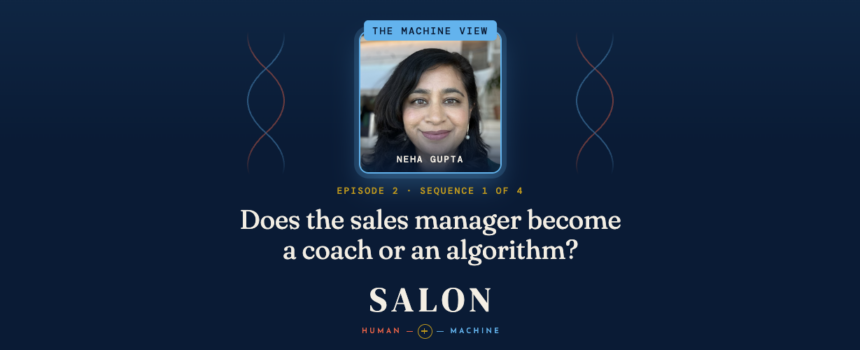
Neha Gupta, Founder & CEO, Breakthrough AI
| Episode | Salon #2 · Part 1 of 4: The Machine View |
| Debate Question | Does the sales manager become a coach or an algorithm? |
| Speaker | Neha Gupta, Founder & CEO, Breakthrough AI (machine view) |
| Website | joinbreakthrough.ai |
| Full Episode | Watch Salon #2 | Listen to the Salon #2 podcast |
Your Reps Know the Script. Can They Do the Work?
Most sales teams don’t have a knowledge problem. They have a practice problem. Reps get the scripts, the books, the frameworks and the onboarding videos. Then they walk into a meeting with a large customer, and nobody knows whether any of it will hold up.
Sales managers feel this more than anyone. They can coach in a one-on-one, but they can’t sit in on every call, and they can’t be sure what a rep will actually do under pressure. All that training still leaves the rep to work out alone how to turn it into everyday behavior. For Neha Gupta, Founder and CEO of Breakthrough AI, that gap between knowing and doing “is really where I think AI can come in.”
Why role play rarely works
Role play should close the gap. It is one of the oldest methods in sales: someone plays the customer, the rep practices the conversation. In most teams, though, it happens too rarely and too gently to change much, for three reasons.
First, it is awkward. A colleague playing the buyer has a working relationship to protect, so they hold back, and the rep practices against a customer far easier than the real ones. Second, it doesn’t scale. A busy manager can fit in one session a week at best, and almost never the hour before a big meeting, when the rep needs it most. Third, the feedback depends on who is in the room and what they happened to notice. The result is practice that is rare, soft and uneven.
What AI sales role play changes
AI role play takes on all three problems at once. An AI buyer has no relationship to protect. As Gupta put it, “You can say anything you want to AI, its feelings are not going to get hurt.” If it is built well, it also stops being polite. Breakthrough AI spent its effort tuning its buyers to keep pushing back, instead of giving in and accepting the proposal or the higher price.
It is also there whenever the rep is: at night, on the commute, or ten minutes before the call. And it scores every conversation against the same rubric, so two reps who make the same mistake get the same feedback, whichever manager they report to. A rep can now rehearse a difficult conversation as often as they need, and be measured by the same standard as everyone else on the team.
The surprise: experienced reps want it most
You might expect new hires to get the most out of AI practice. Gupta expected that too. Instead, she has found that “senior people actually like it more because there’s no emotion behind that feedback.” Feedback from a manager can feel personal, or political. Feedback from a machine is just feedback. When the same note comes back again and again, it gets hard to dismiss. For experienced reps who stopped getting real feedback years ago, that can be the push to drop old habits.
What this means for sales managers
None of this is a case for removing the manager. Gupta sees AI as “the first layer of foundational work”: discovery calls, listening more, asking better questions, and not rushing into product features. Once the basics are covered, the manager gets something they rarely have today: clear data on where each rep is struggling. Coaching can then be specific instead of general, and the hours saved can go to strategy on large deals.
If you lead a sales team, the machine view raises three practical questions:
- How often do your reps actually practice before an important call?
- Would two of your managers give the same rep the same feedback?
- How much of your coaching time goes to basics a practice tool could cover?
Gupta adds one caveat of her own: people still have to design and test the scenarios, because “you cannot totally eliminate humans from the machine learning.” So the machine view is not machine instead of manager. It is machine first, so the manager can coach. Whether that leaves the manager as a coach, or turns the job into reading a dashboard, is the question Andrea Petrone takes on in Part 2.
Pull Quotes
Hearing feedback from a machine is sometimes easier.
— Neha Gupta
I wouldn’t say that that’s what we’re arguing, that it should only be AI and the sales manager role should not exist at all.
— Neha Gupta
The Machine View in Numbers
| Number | Detail |
|---|---|
| Once a week | How often a manager can run a role play, at most, according to Neha Gupta |
| Every few months | How often traditional sales training happens, in her words: “once every six months or once every few months” |
| 24/7 | What no human manager can be, but AI role play can: available anytime |
About the Facilitator
Nikolaus Kimla, founder of Sales POP! and CEO of Coevera, leads every Salon debate. Rather than interviewing the speakers, he gives each side room to make its case, then brings the two views together at the end of the episode.
Next in Salon #2: Part 2, Andrea Petrone makes the case for the human.
Watch the full debate: Salon #2: Does the Sales Manager Become a Coach or an Algorithm?
Related Resources
- Learn about Breakthrough AI’s AI role play for sales teams
- All Salon episodes: salespop.net/media/salon/
- Sales POP! Podcast: salespop.net/media/podcast/
- Coevera: coevera.com








Comments