




Building a RevOps strategy from scratch seems daunting. You need to align three functions with different priorities, integrate multiple technology platforms, establish new processes, and create shared KPIs. Yet successful RevOps implementations follow a clear methodology. This guide walks you through the exact process that leading companies use to build RevOps practices.
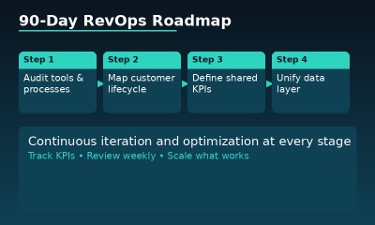
Step 1: Audit Your Current Tools and Processes
You can’t improve what you don’t measure. Start with a comprehensive audit of your current state. Document every tool in your tech stack: CRM, marketing automation, customer success platform, accounting system, business intelligence tool, and any specialized tools (dialer, email, sales engagement, etc.). For each tool, document when it was implemented, how it’s used, its integration points with other systems, and any known gaps.
Then document your current processes. Map the customer journey from first marketing touch through post-sale expansion. Document how leads move from marketing to sales, what criteria determine sales readiness, when customers transition to customer success, and how expansion opportunities are identified. Document each function’s KPIs and how success is measured.
Finally, conduct stakeholder interviews with sales, marketing, and customer success leadership. Ask: What’s working well? What’s broken? Where do leads fall through cracks? Where do customers slip away? Where does information get lost between functions? These interviews surface the biggest pain points and guide your prioritization.
This audit typically takes 4-6 weeks. Schedule 1-2 hour interviews with 10-15 stakeholders. You’ll invest significant time up front, but you’ll avoid building a strategy around assumed problems rather than real ones.
Step 2: Map the Full Customer Lifecycle
With audit data in hand, create a comprehensive customer lifecycle map. This isn’t a sales process or marketing funnel—it’s the complete journey from awareness through expansion. Document each stage, the stakeholders involved in that stage, the success criteria for transitioning to the next stage, and the KPIs tracked at each stage.
A typical B2B SaaS lifecycle looks like: Awareness (marketing-driven) → Engagement (marketing and sales) → Sales Qualification (sales-driven) → Deal Closure (sales-driven) → Implementation (customer success-driven) → Onboarding (customer success-driven) → Growth (customer success-driven) → Expansion (sales and customer success shared) → Renewal (customer success-driven).
For each transition point, define handoff criteria. When does a prospect become sales-qualified? What information must marketing pass to sales? When does a customer transition from implementation to adoption? What success indicators must sales achieve before handing off to customer success? Clear handoff criteria eliminate ambiguity and wasted effort from both functions.
This exercise often surfaces that your current organization lacks clear handoff criteria. Reps don’t know what information marketing will provide. Customer success doesn’t know exactly when to expect customers. Creating explicit handoff criteria is one of RevOps’ greatest gifts—it eliminates friction and ensures nothing falls through the cracks.
Step 3: Define Shared KPIs and Dashboards
Functional silos persist because each function optimizes different metrics. Marketing optimizes for cost-per-lead. Sales optimizes for revenue. Customer success optimizes for retention. Each metric is important, but they sometimes conflict. Better marketing efficiency might reduce lead quality. Shorter sales cycles might reduce customer readiness for success.
RevOps success requires shared KPIs that reward overall revenue growth rather than individual function optimization. Define shared KPIs by stage: Marketing effectiveness is measured by quality and conversion rate of marketing-generated leads, not volume. Sales effectiveness is measured by win rate and deal velocity, not the volume of pipeline created. Customer success effectiveness is measured by adoption rate and expansion revenue, not just retention.
Create a unified dashboard where all functions can see progress toward shared goals. Include leading indicators (activities and metrics that predict future success) and lagging indicators (actual outcomes). Update dashboards weekly so the organization sees real-time visibility to performance and can adjust course quickly.
Importantly, align compensation to shared KPIs. If you create shared KPIs but compensate people individually, nothing changes. Marketing reps should have a portion of compensation tied to lead quality and sales close rates. Sales reps should have a portion of their compensation tied to customer success adoption rates and expansion. Customer success reps should have a portion of their compensation tied to expansion revenue. When compensation aligns with shared success, behavior changes.
Step 4: Unify Your Data Infrastructure
RevOps cannot exist without unified data. Yet most organizations have data islands: the CRM contains customer information but limited lead-source data; the marketing automation system tracks behavior but isn’t integrated with the CRM; and the customer success platform has its own customer information, separate from the CRM. RevOps requires one source of truth where all functions access the same customer data.
Assess your data architecture. Does your CRM contain a complete picture of each prospect and customer? Does marketing automation integrate bidirectionally with your CRM? Is customer success data accessible to sales? Can finance see the source of each revenue dollar? Identify gaps and create a plan to unify your data.
Modern data infrastructure uses a data warehouse or data lake as the central repository. All systems (CRM, marketing automation, customer success, and accounting) integrate with the warehouse. RevOps tools and analytics platforms pull from the warehouse rather than individual systems. This architecture eliminates data inconsistencies and creates a single source of truth.
Data infrastructure improvements take time—typically 3-6 months for integration and data quality work. Budget accordingly and involve IT and data teams early. Many RevOps implementations stumble here because they underestimate the work required for truly unified data.
Step 5: Align Processes and Handoffs
With shared KPIs and unified data in place, redesign processes to eliminate friction at critical handoff points. The most important handoff is marketing-to-sales. Define exactly what constitutes a marketing-qualified lead (MQL) and sales-qualified lead (SQL). Define what information marketing provides at handoff. Define the timeline for sales follow-up.
Establish regular reviews of lead quality and conversion. Weekly, sales leadership should review marketing-generated leads and conversion rates. Marketing should understand why some leads convert and others don’t. Together, they refine the MQL definition and handoff process to improve quality and speed.
Equally important is the sales-to-customer success handoff. Define what customer success must know about each new customer before implementation begins. What is their use case? What is their success criteria? What implementation timeline did they expect? The more information customer success has at handoff, the faster the implementation and onboarding progress.
Finally, establish a customer success-to-sales handoff for expansion. When customer success identifies expansion opportunities, how are these communicated to sales? Does sales have an expansion-focused team, or are existing account managers responsible? How are expansion targets set and tracked? Clear processes here unlock significant revenue growth.
Step 6: Measure, Iterate, and Scale
Rather than designing the perfect RevOps strategy and implementing it company-wide, use a phased approach. Select one high-priority process or function area and run a 90-day pilot. Apply all of the above: unified KPIs, clear handoffs, aligned compensation, and unified data. Measure baseline metrics before the pilot, then track impact over 90 days.
Common pilot areas are: (1) Marketing-to-sales alignment, (2) Sales-to-customer success handoff, or (3) Expansion revenue process. Pick the area with the biggest impact opportunity at your organization. Staff the pilot with your best people and ensure executive sponsorship. Run it for exactly 90 days.
After 90 days, measure impact. Did lead quality improve? Did close rates improve? Did implementation speed increase? Did expansion revenue grow? Use hard data to make the go/no-go decision. If results are positive (and they usually are in well-executed pilots), expand to other parts of the organization. Use the pilot as proof of concept to drive broader change.
Implementation Checklist
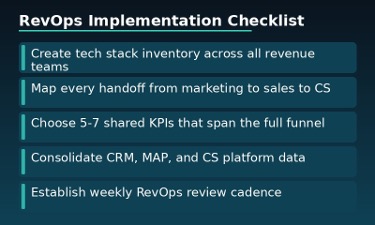
- Complete comprehensive audit of current tools and processes
- Interview stakeholders across sales, marketing, and customer success
- Map the full customer lifecycle with clear stage definitions
- Define handoff criteria between stages
- Establish shared KPIs across functions
- Create a unified dashboard with real-time visibility
- Align compensation to shared KPIs
- Audit data architecture and plan unification
- Integrate CRM with marketing automation bidirectionally
- Implement a data warehouse or a data lake
- Design new processes with clear ownership
- Select a high-impact 90-day pilot
- Establish baseline metrics before the pilot begins
- Execute pilot with the best people and executive sponsorship
- Measure pilot results and make an expansion decision
Getting Started
Building RevOps from scratch is ambitious but achievable if you follow a systematic approach. Start with audit and customer lifecycle mapping. Identify your biggest bottleneck—the one area where misalignment or process friction is costing you the most revenue. Build your pilot strategy around fixing that bottleneck. Scale from there.
Ready to start your RevOps journey? Download our comprehensive RevOps checklist and roadmap to guide your implementation. Or learn more about how to evolve from Sales Ops to RevOps, and discover the latest AI tools that can accelerate your RevOps strategy. Start building your RevOps practice today.






Comments