Sales POP - Purveyors of Propserity
Pipeliner CRM: The Difference Between Values and Principles

Pipeliner CRM: The Difference Between Values and Principles

At Pipeliner we have for quite some time been discussing and promoting principles which we have adopted for our company and made part of our product Pipeliner CRM. These are sound economic and business principles, proven over 150 years of practical use, taken from the Austrian School of Economic Thought, as well as from educator and author Peter Drucker and Fredmund Malik, developer of the Malik Management approach.

At the same time, we’ve seen many other companies talk about their values. What is the difference between values and principles, and why have we chosen the latter?

A Value

A value is something that is generally abstract. In order for it to be put to any sort of practical use, it has to be contextualized into a certain area, a certain society, a certain region, a certain profession or the like. Conversely, values often arise directly from one or more of these and are applicable only to that from which it has arisen. Values can even vary from person to person. Someone can say, “I have a value” and someone else can say, “I have a different value.”

As an example, some societies place high value on bickering and bartering in trade—and consider someone who doesn’t fiercely attempt to lower a price or strike a bargain to be a worthless businessperson. This value would not apply in other social settings where such conduct is considered rude. This is a value, which could also be likened to an attitude or mental stance.

A Principle

A principle, on the other hand, is something that has immediate and universal applicability. The principle expressed in the 7th of the 10 commandments, “Thou shalt not steal” would mean the same anywhere regardless of race, creed, custom or anything else. If a society or a group adapts that principle, it means exactly what it says every time.

At Pipeliner we have adapted business principles, which we also teach through our books, articles and materials—and these can be applied in any country or social structure.

For example, one of the principles we utilize ourselves, and which we’ve made part of Pipeliner CRM, is “Focus on results.” It means to always keep in mind the target you’re trying to attain. This is something that could be immediately applied to any business, in any country, in any language.

The other main principles we apply are:

  • Contribution to the whole
  • Concentration on a few things
  • Utilizing strengths
  • Positive thinking
  • Trust

For a more comprehensive look at these principles and how they are applied within Pipeliner, download and read our free ebook Theory Made Real: Pipeliner CRM Puts Principles Into Practice.

Pipeliner is the only CRM solution based in such sound principles—not simply and only on a list of features we think salespeople and sales managers need.  Get your free trial of Pipeliner CRM now.

Pipeliner CRM: The Driving Force of Globalization and the Digital World

Pipeliner CRM: The Driving Force of Globalization and the Digital World

Digital is the main reason just over half of the companies on the Fortune 500 have disappeared since the year 2000.

–Pierre Nanterme, CEO of Accenture

Why is it that companies that fail to adopt technology fade away?

Fundamental Transformation

First, there is a fundamental transformation happening—actually one that’s been happening for a number of years now but which has reached mammoth proportions and only continues. That is the evolution of the digital world.

50 years ago who would have thought that a person could type something on a computer keyboard in Bangkok, and an instant later it would show up in Boston? Who would have imagined that you could instantly find out everything you needed to know about a company that was trying to sell you something, so that you could really evaluate their offer? Who would have thought that you could gather a majority of opinions from the world over regarding a product or service, in minutes?

That’s the way it is today. And every kind of entity, from an individual all the way up through the mega-corporation, is having to make plentiful allowances for the digital world.

A primary focus of the digital world is processes. A process is the optimization of a task or a set of tasks, either for humans or for automation. Tasks which can be automated surely will be, as we’re seeing with the continuous advancement in robotics. Other sets of tasks, such as with sales processes, are meant for human interaction and use. Processes are what make it possible to operate at optimum speed so as to compete in today’s business world.

Another very important focus is the harnessing and use of data trends. For example, medical analysts can watch data trends for certain types of medicine being sold in a certain area, and be able to state with certainty that a flu is going around in that region, and act accordingly. With Google Trends anyone can see what is trending near them or in any place throughout the world as regards searches. Businesses take advantage of this kind of functionality for everything from marketing to product development.

Overwhelming Complexity

But there is another, radical change brought about by the digital world that must be dealt with head-on, as it will overrun anyone who doesn’t.

While the whole world has become interconnected, that means that all the information coming from everywhere is literally available to everyone, practically as soon as it is released. What kind of information overload can that lead to?

One might also ask how easy it is to stay abreast of information just in one’s own area of expertise. Several centuries ago, the major information possessed by the entire world was at the fingertips of the leading minds of the day. This was so true that someone like Leonardo da Vinci could be a leading light in many different fields; he was a painter, an inventor, an architect, an astronomer, a scientist, a writer and a number of others.

Today, though, simply trying to keep current on the latest information in one of these fields would require more time than the average human has in a day—even if they never slept.

There are 2 drivers to this major problem:

  1. The speed of innovation
  2. The exponential growth of every area of life

For an example of the mind-boggling complexity that is coming at us every day, let’s return to a discovery made all the way back in 2003. 13 years ago, with the use of the Hubble telescope, calculations took place that demonstrated to us the approximate number of galaxies in the universe.

With the Hubble telescope, the entire visible sky was mapped. Remember, the Hubble telescope is in space, so the “entire visible sky” is the entire sphere of space, visible in every direction. The sky was mapped using Hubble deep field squares. After examination, it was estimated that each of the 65,000 deep field squares contained 10,000 galaxies. Multiplied out, that makes for an estimated 16.5 billion galaxies. That totally boggles the mind! We haven’t discovered a tiny fraction of 1 percent of the universe.

So as you can see, just in our lifetimes things have been discovered that are beyond the ability of us to imagine. There are surely many more to come.

Pipeliner CRM

Along with the rest of the world, sales has become increasingly complex, too. Where once there was simply a couple basic hats—a “salesman” and the manager—today we have field sales, inside sales, SDR sales, vertical sales, horizontal sales, and much more. Because of the digital age, we also have many more times the sales channels we once had.

In addition to applying sound and proven business principles, at Pipeliner we have also been searching for a way to address today’s overwhelming complexity. We weren’t going to go the way of many other applications, and display hundreds of charts and graphs (as, for example, financial market applications do). Interestingly, our legacy CRM competitors have always dealt with sales complexity in this way. In so doing they have made sales next to impossible to truly bring under control.

Not long ago I was on an international flight and found myself seated next to a Boeing 747 cargo pilot (traveling as a passenger). I told him that I was fascinated with the cockpit of an airliner, just because there were well over a hundred instruments there. I then asked him what he did under extreme circumstances—how many instruments would he really be paying attention to? He told me, “Not more than 4 or 5.”

The human mind cannot track hundreds or even dozens of indicators—so in day-to-day management, what is the answer?

For that, Pipeliner CRM turned to cybernetics, the specific science applied in dealing with complexity. Cybernetics pioneer W. Ross Ashby referred to cybernetics as the “science of simplification.” The first application of cybernetics to Pipeliner came with our last release, in which we added our Navigator feature.

With its breakthrough Navigator functionality, Pipeliner CRM moves far beyond the standard concept of a CRM dashboard. We have brought more focused and innovative ways of bringing instant intelligence to all users, no matter their function in the organization—intelligence that cuts out the noise for users, allowing them to easily navigate complexity and focus immediately, and in real-time, on what is most important.

We aim to assist sales managers and salespeople navigate the complexity of today’s sales world. And by doing so, we are greatly helping them to master it and succeed.

Pipeliner CRM is the perfect CRM for competing and succeeding in today’s digital world.  Get your free trial of Pipeliner CRM now.

CRM is Key Finding in LinkedIn State of Sales Report 2016

CRM is Key Finding in LinkedIn State of Sales Report 2016

LinkedIn recently released its State of Sales in 2016 report—which found that Salespeople rely on a variety of sales technologies, but spend the most time using CRM solutions and social selling tools, and believe both deliver the highest value.

Through our blogs, ebooks and even through our recent product releases, we at Pipeliner have been, for the last few months, pointing out the crucial need for CRM in addressing the frantic pace and level of confusion in today’s business world. Our most recent release, Automata, actually employs the science of cybernetics to assist salespeople and sales managers in navigating the incredible complexity of today’s sales landscape. Our next release, scheduled for July of this year, brings even more simplifying tools and benefits to salespeople everywhere.

It is evident that LinkedIn, through this report, has come to similar conclusions with regard to the need for CRM.

Specifics

When it came to highlighting the amount of time spent with CRM, the report found that one-third (33 percent) of CRM users spend 3-5 hours per week using CRM tools. Almost one quarter (24 percent) spend more than 10 hours per week using CRM tools.

Sizes of businesses also played a role in CRM usage, at least according to this report. 44 percent of employees at medium-sized companies (100-999 employees) use CRM tools in comparison to only 23 percent of employees of small companies (under 100 employees) and 27 percent at large companies.

The report was based on a survey commissioned by LinkedIn, and conducted on 1,017 sales or business development professionals in the United States in December 2015/January 2016 by Market Cube, a research panel company.

Pipeliner is the best possible CRM solution for navigating today’s sales complexity. It is Instant Intelligence, Visualized! 

Pipeliner CRM: Future Prosperity Depends on Sound Education

Pipeliner CRM: Future Prosperity Depends on Sound Education

All that helps today is that we have a better idea, and the better idea is a fight against the bad idea. The weapons that we have are not armored. We have no hymns, we have no flags, we have no rifles. The only thing we have is our idea, and we bring that idea into the light. And when people understand it, the better idea will one day succeed.

– Ludwig von Mises
Economic Policy: Thoughts for Today and Tomorrow

Here at Pipeliner, we have taken what von Mises says totally to heart. We believe that education with ideas is the most important activity in which we are engaged. We believe that if we keep pushing out a great idea, one day people will say, “That makes sense! 2 plus 2 is 4!”

Once more, you can see that we’re not just about the Pipeliner CRM solution only.

Education and Sales

Why would the developer of a sales tool believe so much in education? And why do we believe education is so closely tied to sales?

The original purpose of sales—though it may not be so obvious today—was education. The salesperson educated the potential buyer about a product or service. Once that education was complete, the buyer would either say, “You’ve educated me for nothing! I see no value!” or “You have educated me on something that will help me, and that is why I will buy your product.” Education clearly showed the buyer the inherent value of the product or service.

Education in Sales Still Needed?

Today there is an enormous amount being written about the changes in buyer behavior. The gist of it is, buyers are educating themselves online about products, and by the time they contact a salesperson they’ve already made 70- 80% of their decision. Therefore a salesperson is no longer in the business of educating prospects.

As someone engaged in the business of sales, as well as being engaged in the business of providing a software product for salespeople, I politely beg to differ.

For one thing, as products move up the scale of complexity, there is much that cannot be quickly or adequately described in web pages or online materials. Where are prospects going to turn for information on these? Sales reps, who are today’s product experts.

But even with products that aren’t so complex, for a full understanding of how they might be applied within that prospect’s business or with their particular application, it would still be very beneficial for a prospect to be educated by a salesperson.

Empathy

A noteworthy point is that, whenever a salesperson is educating a prospect, the salesperson should remain at “eye level” with the prospect. In other words, not “looking down” at the prospect or being condescending.

This is where empathy comes into the sales process. In order to really empathize with a prospect and fully understand what they are going through, a salesperson must do everything they can to put themselves in the place of the prospect—that’s what empathy actually is.

Interestingly, that is also where empathy comes into education itself.

Pipeliner and Education

If you look through our web site, you’ll see we have created a tremendous number of educational materials. These include blog articles, tips and tricks, ebooks and ebooklets, videos, white papers, infographics and much more. We have even built education into the Pipeliner CRM product itself.

To say the least, we are big believers in education—not just about our product, but about sales, leadership and anything else relevant to the world of business in which we can help. Most of our materials are provided free of charge—we really want to help educate and change the business world for the better.

Education and Application

In looking through our educational materials, you’ll see that they are totally geared toward application. If you read or learn something, we believe you should be able to turn around and apply it. Otherwise, why learn it?

I personally believe that this is the future of education in general—it will move away from being so theory-oriented and will be completely structured around applicability.

At Pipeliner we believe in having data arranged around a goal, just as we have done in our product. The goal is that you do something that brings you a benefit, and you learn because the data is proven on principles. And it’s not theoretical, it’s practical.

That is where the Pipeliner Knowledge Factory enters in.

Pipeliner Knowledge Factory

This issue of theoretical versus practical instruction might be best expressed in this humorous quote attributed to Mark Twain: “Never let schooling interfere with your education.”

In keeping with our commitment to practically applicable education, we have begun the Pipeliner Knowledge Factory. We have given our educational division this name because sales—the main subject of our works—is a production activity, not a theoretical one.

Why didn’t we call it a school? Because when people speak of school, you find that many didn’t like it. Many had bad experiences there—most weren’t returning home from school every day and saying, “Wow! That’s fantastic!” For them it was boring and even sometimes tragic. This attitude has certainly been expressed in music throughout the years, a classic example being 1979’s The Logical Song by Supertramp:

When I was young, it seemed that life was so wonderful,
A miracle, oh it was beautiful, magical.
And all the birds in the trees, well they’d be singing so happily,
Joyfully, playfully watching me.
But then they send me away to teach me how to be sensible,
Logical, responsible, practical.
And they showed me a world where I could be so dependable,
Clinical, intellectual, cynical.

We also didn’t call our educational effort a university, because the university in the real world has a different agenda—one that is more theoretical and reflective. And while we feel it is important that people receive a university education, most of what is taught there is not immediately applicable. For similar reasons, we didn’t use the word academy.

In a factory, you can learn a craft, which has specific steps and can be precisely taught, as opposed to an art, which is far more instinctive and nebulous. Sales, as we’ve said many times, is a craft.

The focus of the Pipeliner Knowledge Factory is to produce information that can be instantly used. While the knowledge we are imparting comes out of business principles, it is practical in its application. It assists in business success by helping minimize risk and leverage opportunities.

Pipeliner is the only CRM solution based in such sound principles—not simply and only on a list of features we think salespeople and sales managers need.


How is Leicester City Football Club Like Pipeliner CRM?

How is Leicester City Football Club Like Pipeliner CRM?

As much of the world now knows, England’s Leicester City Football Club, otherwise known as the Foxes, has come from virtually nowhere to win the 2015-2016 Premier League victory. Nobody saw it coming—a year ago the team was in last place, with 9 games to go.

As noted in more detail in a brand-new ebooklet, Pipeliner Sales shares a lot in common with the Leicester City Football Club.

Humble Beginnings

Leicester City Football Club began their heroic run in last place. Something—the more superstitious among us would say the reinterment of King Richard III’s remains in Leicester—changed all that. They began winning, then they began totally shutting out the competitors. In the end, they came from nowhere to the top.

Pipeliner has also come from virtually nowhere, humbly beginning in Vienna, Austria. We made the move to America in 2013, and virtually nobody knew who we were. Since then, we’ve had consistent year-over-year growth of 100%.

No “Stars”

Now that Leicester City has achieved such an incredible victory, a number of its players will now be viewed as stars (notable examples Goalkeeper Kasper Schmeichel and striker Jamie Vardy). But prior to its incredible triumph, the team sported no “star power” of the likes of Lionel Messi, for example. The team simply had incredibly talented and experienced players that, in the end, brought them through.

The same could be said for Pipeliner. While we don’t (yet) have business-fame A-listers, we have a tight, powerful team of great experience that have brought Pipeliner through to its incredible success thus far. In addition to its 100% year-over-year growth, we have developed an amazing, well-reviewed product that has become a major contender on the world stage.

Up Against the Giants

As Leicester City rose through the ranks, it certainly came up against far better financed and extremely powerful teams such as the Manchester clubs, City and United. Yet no matter the competition, the Foxes faced them down and vanquished them.

Pipeliner, too, has been up against some incredibly well-funded and powerful competitors, some of which are many times our size as a company. Yet we have not only shown we can grow at rates equal or better than those competitors, but have proven with real statistics how much superior our product is:

Who Cares? Then…and Now

When Leicester City began its amazing run to victory, very few people outside their home town were paying any attention to them. But as they began their rise, people began paying attention in ever-greater numbers. And today, the whole world is watching.

Likewise, when Pipeliner first came to America in 2013, almost nobody knew who they were and, as with Leicester City, most didn’t care, either. But Pipeliner has not only attracted the avid ever-increasing interest of customers, but the media, too: Leading lights such as Forbes and The Wall Street Journal are now watching Pipeliner with keen interest.

The Best are Simply The Best

The moral of the story? The best are the best—whether well-financed and famous, or unknown yet fantastically skilled and hard working.

Leicester City Football Club has proven it beyond a shadow of a doubt. And here at Pipeliner, we’re proving it, too!

Find out why we’re the best! Try a free trial.

Brand New Pipeliner Mobile CRM: Pipeliner On the Go

Brand New Pipeliner Mobile CRM: Pipeliner On the Go

Concurrent with the release of the Pipeliner CRM’s breakthrough version Automata, we are also very proud to be releasing a brand new mobile CRM version! The new Pipeliner Mobile CRM App brings key Pipeliner functionality to iOS and Android Smartphones.

Pipeliner CRM acts as a guide through today’s sales complexity, bringing focus and clarity to a salesperson’s job. It is instant intelligence, visualized. But today’s salespeople are most often not chained to desks in offices—they are out and about, visiting sites, giving presentations, attending conferences and trade shows. We wanted to make sure that no matter where a salesperson is located, Pipeliner CRM is always accessible.


Pipeliner Mobile CRM brings key Pipeliner functionality to mobile CRM, including:

Account Management

Access or edit account data right from mobile. For instance, you’re at a trade show, and you run into Bob Smith from the XYZ company, who also introduces you to his colleague Randy Johnson. Both provide cards. Afterward, you look up XYZ company in Pipeliner mobile Account Management, and you find Bob’s name in his former position at XYZ (he’s obviously been promoted). You update the data in Pipeliner to reflect Bob’s current situation. Then you find that Randy Johnson isn’t in Pipeliner at all, so you add him as a contact for the XYZ company. Learn more about Pipeliner Mobile Account Management here…

Contact Management

Keeping prospect and client contacts accurately recorded in CRM is crucial to selling—you want to make sure you are reaching the right contacts, at the right companies, at the right time. For example, one day you’re out at lunch and remember there is a contact at one of your prospect companies that you really would like to reach out to. Contact data is just a click away—and you’re able to do so. Learn more about Pipeliner Mobile Contact Management here…

Lead Management

Leads are the lifeblood of any sales organization–and in reality, of any company. Therefore lead management doesn’t just happen when a salesperson is at a desk in the office–it can and does need to happen anywhere. For instance you’re at a trade show, conference or other similar function, and collect a lot of business cards. In off moments, you can enter the new leads into Pipeliner through the Pipeliner CRM Mobile App. Learn more about Pipeliner Mobile Lead Management here…

Opportunity Management

Since a salesperson is often away from the office, their Smartphone may be their only connection with CRM, and the opportunity data they need to view and update. For example, you’re waiting in the airport after a successful client visit, and receive an email that your deal with another prospect has closed! You can enter that fact into their opportunity data in Pipeline mobile so that your manager will see it. Learn more about Pipeliner Mobile Opportunity Management here…

Additionally, Pipeliner Mobile CRM brings these additional Pipeliner features to mobile:

Try a free trial of Pipeliner CRM now. It’s Instant Intelligence, Visualized!

The Real Power Behind Pipeliner CRM Navigator

The Real Power Behind Pipeliner CRM Navigator

Pipeliner’s newest and most powerful feature is Pipeliner Navigator—the first view seen when Pipeliner is opened. Navigator takes CRM far beyond the traditional dashboard view, providing instant intelligence specifically tailored to that user, allowing them to easily navigate complexity and focus immediately, in real-time, on what is most important.

Once you use Navigator, you’ll see how far it exceeds any similar feature in other CRM applications. There is very sound reason for this—Navigator is based in very proven and powerful economic and scientific principles.

A Brief “Behind the Scenes” History of Pipeliner CRM

Pipeliner CRM has, from the beginning, had its roots in such principles. Several years back we had been studying the Austrian School of Economic Thought, which places the entrepreneur front-and-center in economic theory. At the time we realized that a salesperson is actually an “entrepreneur within the enterprise,” and coined a new term to describe the salesperson: salespreneur.

We then realized that the concept of Pipeliner also embodied various economic principles from the Austrian School of Economic Thought—and so we brought these into the program as well.

Moving forward, we realized that sound management principles were also needed. In truth, there is good or bad management—there is no in-between. In our own company we adopt and follow the management principles of economist and management scientist Fredmund Malik. So we incorporated these into Pipeliner, too.

Today we see that the complexity in the world is only increasing. We certainly witness such complexity in sales—with data, leads, opportunities, the sales cycle, multiple pipelines, multiple companies, multiple product lines, tier pricing, and much more.

So today we have arrived at the best possible way to face and deal with this complexity.

Cybernetics and Complexity

The best definition of the word cybernetics that I know of comes from cybernetics pioneer W. Ross Ashby, who defined it as the “science of simplification.” The science of cybernetics is employed to approach and understand complexity.

Cybernetics simplifies complexity by providing models of systems that are too complex for the viewer to understand without some kind of assistance. These models act as dynamic moving maps of these complex systems. They are real-time navigators that enable shared understanding and communication.

Interestingly, the root of the word “cybernetic” is the Greek kubernētēs, which means “steersman,” one who steers a boat. With cybernetics as a background, we have designed Pipeliner Navigator for the purpose of safely navigating a sales representative—and therefore a sales team and business—through the world’s growing complexity.

Visual Models

With Pipeliner Navigator we are presenting a rep with the data they should have to proceed—much as the navigator on a ship or an aircraft would present navigational data to the captain. It is still up to the captain to guide the ship in its actual voyage.

Put another way, we are presenting the salesperson with visual models to plot a course to success. The sales rep can then take that data—that instant intelligence, visualized—and utilize it to proceed forward toward the target in the most efficient way possible.

Such a powerful tool takes a salesperson’s attention off of all the details—now details are right there in front of him or her, not inside their head. They can put their full attention on moving forward toward that target.

Navigator visually prioritizes a rep’s tasks, activities, and opportunities. In Navigator’s target view, the rep can see, in real-time, how they are proceeding toward attaining their target. This display can be customized by target type, by quota and by time period so that they really understand what is needed to make it.

At any time, the salesperson can drill down and readily see any of the opportunities that make up the target, and what needs to be done with that opportunity.

Sales Manager

Navigator is an extremely useful tool for the sales manager as well. The sales manager can utilize Navigator, through Pipeliner’s Profiles feature, to look at the opportunities, tasks and priorities for any single rep, a sales unit or the whole team. Of course, the sales manager can also utilize Navigator for their own tasks and priorities.

The Future

The future for Pipeliner CRM will always go along the lines of proven scientific concepts and principles. Join us in our journey—for your business success!

Pipeliner CRM Automata: Bringing Vitally Needed Simplicity to Today’s Overwhelming Complexity

Pipeliner CRM Automata: Bringing Vitally Needed Simplicity to Today’s Overwhelming Complexity

If anything could be said about today’s world, it’s certainly filled with complexity. Today’s sales landscape is reflective of this trend: complexity in data, leads, opportunities, the sales cycle, multiple pipelines, multiple companies, multiple product lines, tier pricing, and much more.

How can salespeople and sales managers deal with all this complexity? Well, we have at least one answer: with Pipeliner CRM, and it’s new version: Automata.

Okay, What’s With the Name?

Automata was a work written by Greek mathematician Hero of Alexandria (c10-c70 A.D.). It was a description of machines which enabled wonders in temples by mechanical or pneumatic means. Two thousand years ahead of its time, Automata is considered some of the first formal research into the science of cybernetics.

Cybernetics

Cybernetics is the study of how machines can be created to think and act like humans. But cybernetics is also described as the “science of simplification” and is used to approach and understand complexity.

Cybernetics simplifies complexity by providing models of systems that are too complex for the viewer to understand without some kind of assistance. These models are real-time navigators that enable shared understanding and communication.

And with that concept, we move right into Pipeliner CRM Automata.


Navigator

The prime feature of Pipeliner CRM Automata is its new Navigator feature. With Navigator, Pipeliner has totally parted ways with the traditional concept of a CRM dashboard and is providing far more innovative and targeted ways to deliver instant intelligence to the user. With it the user can cut out the noise, navigate that complexity and focus right in on what is most important.

Pipeliner Navigator is composed of 5 basic components:

  • Activity Stream—This is a list of activities, tasks, and opportunities in date order, beginning with the closest to the present, displayed on the right-hand side of Navigator. You can click on any item to drill down and get the full information on what needs to get done. All priority items are here, in one convenient, visual location.
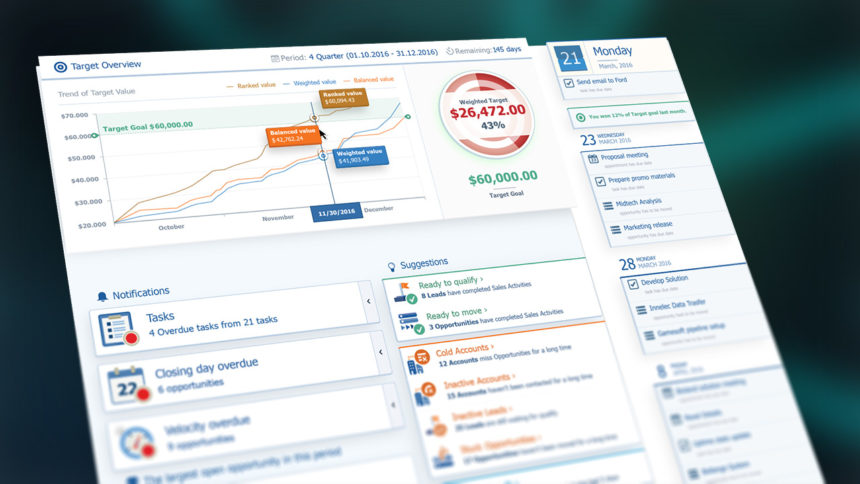
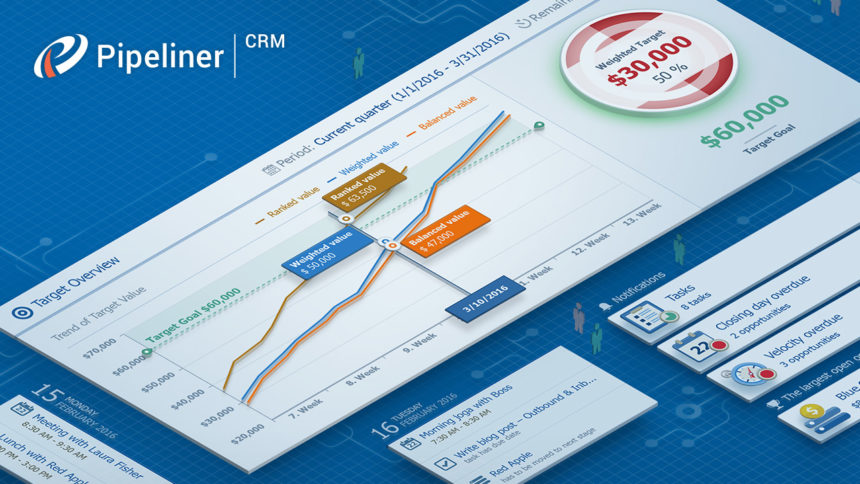
  • Target Overview—This component combines our Dynamic Target feature with a Target Trend graph that displays progress toward a sales goal over a specified time period, using 3 different metrics. Pipeliner users always know where they are at in relation to a target, and what needs to be done to get there.
  • Notifications—This section contains “Tasks,” “Missed Close Dates,” “Velocity Issues” and “Largest Open Opportunity”–all important notifications of various issues within a user’s pipeline.
  • Suggestions—In this section can be seen other areas in which actions should possibly be taken. These include Cold Accounts, Inactive Accounts, Inactive Leads, Stuck Opportunities, New Leads and more. This component is always providing guidance to help improve a rep’s performance.
  • Business Overview—This section provides a graphical display of Open Opportunities, Open Sum, Won Sum, and Lost Sum—for the user-defined date range for which Navigator is currently set. A user can look in the rear-view mirror to see what has already happened, and look forward to assessing where they are going– allowing them to make the necessary adjustments for the road ahead.


Forecast Report

Automata introduce a new Pipeliner report: the Forecast Report. It allows a sales manager to set quotas for each member of a sales team, and track quota achievement through a sales period for each quota set.

Like many Pipeliner features, the Forecast Report is fully customizable can be filtered with profiles, and shared with team members.

Dynamic Dropdowns

This new functionality allows user-defined drop-down menus to dynamically relate to one another. For example, if a particular sales territory is selected, then another dropdown menu of “sales reps” would only be those reps for that territory.


User Rights Management—Greatly Simplified

Administrators will be very happy with the ease of which user rights can now be managed, within Pipeliner Automata, in several different areas.

Pipeliner Automata is a major leap forward for Pipeliner CRM. If you have yet to try Pipeliner, the time has never been better! Do it today.

This website uses cookies. By continuing to use this website you are giving consent to cookies being used. For information on cookies and how you can disable them, visit our privacy and cookie policy.