


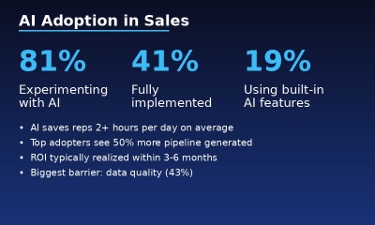
According to recent industry research, 81% of sales organizations are now experimenting with AI tools, yet only 41% have fully deployed AI-powered solutions. The tools you choose today will determine whether your sales team operates at peak efficiency or falls behind competitors. In this comprehensive guide, we review the most impactful AI sales tools transforming B2B sales in 2026 and provide a framework for selecting the right stack for your organization.
How AI Is Transforming B2B Sales
Artificial intelligence is reshaping every stage of the sales process. From lead generation to deal closure, AI tools automate routine tasks, uncover hidden insights, and enable sales reps to focus on high-value activities. The transformation spans multiple dimensions: predictive analytics to identify the most promising leads, conversational AI to qualify prospects 24/7, and real-time call coaching to improve win rates.
The ROI is measurable. Organizations deploying AI sales tools report 20% improvements in productivity, 15% increases in deal velocity, and 25% higher average deal sizes. What was once the domain of large enterprises is now accessible to mid-market and emerging companies, democratizing access to enterprise-grade sales intelligence.
The AI sales revolution is driven by three core trends. First, the explosion of sales data creates opportunities for machine learning models to uncover patterns humans miss. Second, cloud infrastructure makes AI tools affordable and scalable. Third, regulatory clarity around data privacy has eliminated uncertainty that previously slowed adoption. These converging factors have created the most dynamic sales technology landscape in a decade.
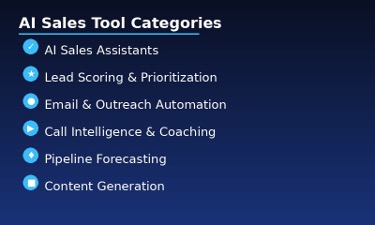
AI Sales Assistants and Conversational AI
Conversational AI platforms like Drift and Conversica are revolutionizing first-touch prospecting. These tools engage website visitors, qualify leads, and schedule meetings without human intervention. Drift, deployed on 50,000+ websites, has proven that AI-driven conversations generate 5x more qualified leads than passive form submissions. The platform engages visitors in real-time, answering questions and collecting qualification data.
Conversica takes a different approach, using email-based AI assistants to follow up with cold prospects across multiple touches. The platform achieves 40-50% response rates from prospects who previously ignored follow-up emails, demonstrating the power of AI-powered persistence and personalization. Both platforms integrate with CRM systems, ensuring every lead captured is immediately available to your sales team.
The business case is compelling: conversational AI reduces sales development costs by 30-40% while improving lead quality. Reps no longer waste time on initial qualification; instead, they focus their energy on prospects with genuine buying intent. Companies like Slack, Twilio, and HubSpot use these platforms to continuously feed their sales pipelines.
AI Lead Scoring and Pipeline Forecasting
Lead scoring has traditionally relied on explicit engagement data and manual qualification rules. Predictive lead scoring platforms like Clari and 6sense fundamentally changed this by incorporating hundreds of firmographic, behavioral, and intent signals into machine learning models that predict which leads will close. Clari’s AI analyzes conversations, email patterns, and deal progression to forecast quarter-end revenue with 95% accuracy.
6sense uses intent data collected across the web to identify companies actively researching your solution. The platform combines first-party data from your website and email with third-party intent signals to create a real-time view of market demand. Customers report that intent-based targeting improves win rates by 30-40% because you’re reaching prospects already in buying mode.
Pipeline forecasting powered by AI eliminates guesswork from revenue planning. Rather than relying on rep optimism or hindsight, AI models analyze historical deal progression patterns and current activity to predict what revenue will actually close. This visibility allows sales leaders to adjust strategy mid-quarter rather than discover shortfalls at month-end. Organizations using AI forecasting improve forecast accuracy by 25% on average.
AI Outreach and Email Automation
Outreach and Salesloft dominate the AI-powered outreach and engagement automation category. These platforms orchestrate multi-touch sequences across email, SMS, phone, and social, automatically personalizing each message based on prospect behavior and firmographic data. Outreach’s AI learns from your best-performing sequences and recommends optimizations that increase response rates.
What differentiates modern AI outreach tools is real-time personalization at scale. Rather than sending the same email to 500 prospects, these platforms customize subject lines, opening lines, and value propositions based on company size, industry, job title, and recent web activity. Salesloft customers report 30% higher response rates with AI-personalized sequences than with standard templates.
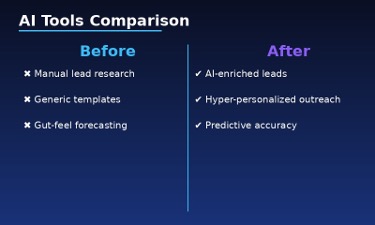
Email automation without personalization is dead. Prospects immediately recognize generic bulk emails and delete them without reading. AI changes the game by making true one-to-one personalization economically feasible for outbound prospecting at scale. When combined with intent data and predictive lead scoring, AI outreach becomes a precision tool rather than a volume play.
AI Call Intelligence and Sales Coaching
Gong and Chorus use advanced speech recognition and natural language processing to automatically transcribe, summarize, and analyze sales calls. Every conversation becomes a learning opportunity as AI identifies what behaviors separate winning reps from struggling ones. Gong analyzes conversations to reveal patterns: successful reps ask 8-10 discovery questions while struggling reps ask 3-4; winning conversations contain 3-4 mutual silences while losing calls contain minimal pauses.
These insights drive real-time coaching. Call Intelligence platforms alert managers during deals when a call takes a turn, enabling intervention while there’s still time to salvage the opportunity. Post-call, AI generates comprehensive summaries of key discussion points, action items, and next steps, eliminating manual note-taking and ensuring consistency across your team.
The impact on sales effectiveness is dramatic. Organizations that use call intelligence platforms improve average deal size by 15-20% because coaching becomes data-driven rather than relying on a manager’s intuition. Sales reps improve faster because they receive specific, actionable feedback rather than generic criticism. Call recording and analysis also provide compliance visibility, which is essential for regulated industries.
How to Choose the Right AI Sales Stack
Selecting the right AI sales tools requires a systematic approach. Start by mapping your current sales process and identifying bottlenecks. Where do you lose deals? Where do deals stall? Which reps underperform, and why? Once you’ve diagnosed the core challenges, evaluate tools based on their ability to address those specific problems rather than buying into hype.
Consider integration carefully. The best individual tools fail if they don’t talk to your CRM, phone system, email platform, and other essential systems. Evaluate whether the AI platform integrates natively or requires custom API development. Also assess data governance: ensure the tool complies with your privacy requirements and uses customer data responsibly.
Start small and measure impact. Rather than attempting a comprehensive AI overhaul, pilot a single tool with a subgroup of reps or for a specific use case. Establish baseline metrics before implementation, then measure adoption rates, engagement metrics, and business outcomes after implementation. This data-driven approach lets you quantify ROI before scaling to your entire organization.
Finally, invest in change management. The best technology fails without adoption. Ensure your team understands how AI tools improve their work rather than replace them. Highlight how AI eliminates tedious administrative work, allowing them to focus on high-value selling activities. When reps experience productivity gains and revenue increases, adoption becomes self-sustaining.
The Path Forward
AI in sales is no longer a future vision—it’s the operational standard at leading companies. The question isn’t whether to adopt AI, but when and how. Early adopters are already capturing market share through superior sales productivity and customer experience. Every quarter you delay is a quarter your competitors gain an advantage.
The good news: AI sales tools have never been more accessible. Modern platforms offer flexible pricing, quick implementations, and proven ROI. Whether you’re a startup building your first sales team or an enterprise optimizing existing operations, there’s an AI tool designed for your stage.
Ready to transform your sales organization with AI? Pipeliner CRM integrates AI-powered lead scoring, call intelligence, and predictive analytics directly into your sales workflow. Try Pipeliner’s AI features today and see how predictive intelligence can accelerate your deals and grow revenue.






Comments