




Everyone’s selling AI forecasting. Most of it doesn’t work. This is a practical reality check on what AI can do in sales forecasting, where the hype breaks down, and what actually matters.
What AI Forecasting Can Actually Do
AI is good at pattern recognition. It can identify correlations between deal characteristics and outcomes faster than humans can. It can process historical data at scale. It can detect when a deal is behaving differently from similar deals. That’s genuinely useful.
Good AI forecasting answers questions like: Based on this deal’s stage, size, industry, and speed, what’s the probability it closes this month? How does this deal compare to others we’ve won at this stage? What deals are at highest risk of slipping? These are the questions AI can help with.
What AI Forecasting Cannot Do
AI can’t predict the future. It can only extrapolate patterns from the past. If your market is changing, if you’re entering new verticals, if your sales process is evolving, historical data is less predictive. AI can’t account for a major customer bankruptcy or a competitive threat that’s never happened before. AI can’t know about a deal your rep hasn’t entered into the system yet.
AI also can’t predict behavior it hasn’t seen. If your historical data is biased (underrepresenting certain sales processes or rep styles), AI will amplify that bias. If your deal data is messy (deals sitting in stages for months, reps gaming the pipeline), AI will learn bad patterns.
Where AI Forecasting Fails Most Often
AI forecasting fails when the data is poor. Garbage in, garbage out. If your CRM is full of stale deals, incomplete information, or deals that don’t actually represent your sales process, AI will struggle. It fails when sales processes are inconsistent. If one rep stages deals differently from another, if stage definitions are fuzzy, AI has nothing clean to learn from.
It also fails when it’s treated as a black box. Vendors who can’t explain why a deal has a 60 percent probability aren’t actually using AI. They’re using a random number generator. Real AI forecasting should be explainable. You should be able to see which factors influenced the prediction.
The Accuracy Problem
Vendors claim 90 percent accuracy. That’s marketing. Real-world AI forecasting accuracy ranges from 65 to 80 percent, depending on data quality and process maturity. And accuracy is a useless metric on its own. A forecast that says every deal will close is 50 percent accurate but worthless.
The real measure is improvement. Does AI forecasting do better than your sales leaders’ gut feel? Does it do better than a simple statistical model? Most of the time, yes. But not always, and not by much. And if your sales leaders have 20 years of experience in your market, AI might not beat them on a small or mature pipeline. But it’s useful for scaling. It’s useful for flagging deals that behave differently from expected. It’s useful for reducing the bias in your forecast.
How to Actually Use AI Forecasting
First, get your data clean. This is non-negotiable. Spend a month ensuring every deal in your system has a stage, a close date, a deal size, and key attributes filled out. This is the foundation. Without it, AI will struggle.
Second, treat AI forecasting as a check on judgment, not a replacement for it. Your sales leader should still review the forecast. They should question deals that AI ranks differently than they expect. They should override AI when they have information the system doesn’t. This human-AI hybrid is where the value lives.
Third, give it time to learn. Most AI forecasting systems need at least three months and 100 deals to calibrate. Don’t expect perfect predictions in week one. And do monthly retraining as your business evolves.
Fourth, focus on trends, not individual deals. AI is better at predicting portfolio behavior than individual deal outcomes. Use it to spot when your overall pipeline is strengthening or weakening, when certain segments are underperforming, and when deals are moving faster than expected.
The Questions to Ask Vendors
- Can you explain why you’re giving each deal that probability? Real AI says yes.
- What factors drive your forecast? You should be able to see the model.
- What’s your actual accuracy in my industry? Get references.
- How often do you retrain? Monthly is standard. Less than quarterly is a red flag.
- What happens if my data is messy? They should tell you exactly what happens, then help you clean it.
The Bottom Line
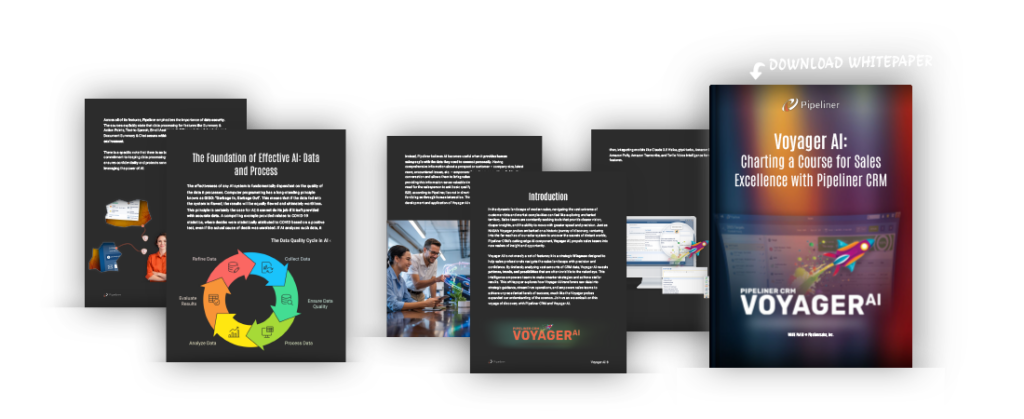
AI forecasting is useful, but it’s not magic. It’s a tool to reduce bias, process patterns at scale, and flag anomalies. It works best when your data is clean, your sales process is consistent, and you treat it as one input into a human decision, not the decision itself. Be skeptical of vendors who claim impossibly high accuracy. Be curious about vendors who can explain their model. And remember: the best forecast is one your team trusts enough to act on. Pipeliner CRM’s Voyager AI offers explainable forecasting that learns from your process.
About Sales POP!
Sales POP! is a multimodal resource hub for salespeople, sales managers, and sales leaders across all industries. Visit salespop.net for expert interviews, podcasts, articles, and tools that help you sell smarter.




Comments