


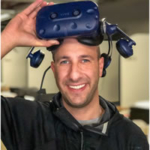
For decades, the trade show formula has barely changed: branded booths, breakout sessions, giveaway trinkets, and a bowl of candy. But a growing number of brands are discovering that the most powerful way to connect with prospects isn’t through a flashier booth — it’s by transporting them somewhere else entirely. SalesPOP! host John Golden sat down with Amir Berenjian, founder and CEO of REM 5 Studios, to explore how VR, AR, and spatial computing are transforming how brands tell stories, engage audiences, and drive measurable results.
From Wall Street to Virtual Worlds
Berenjian’s path to immersive technology wasn’t linear. After studying business in college, he landed in investment banking, where he spent years working alongside family-owned businesses and entrepreneurs — an experience he describes as a real-world PhD in how business actually works. But in 2016, he tried the Oculus Rift for the first time and became obsessed with the idea that immersive technology could democratize experiences. He left banking that same year, founded REM 5, and opened a physical VR location in 2018 to solve what he saw as the biggest barrier to adoption: accessibility. The technology was impressive but fragmented, expensive, and difficult to set up. His mission from day one was to package it on a silver platter.
Start with Why — Not with the Headset
One of the most valuable takeaways from the conversation is Berenjian’s insistence on working backwards from the use case rather than the technology. When marketing teams come to REM 5 with ideas for VR tours or product showcases, his first question isn’t about the creative — it’s about distribution. Who will actually put on the headset, and where? Too many companies, he argues, build impressive VR experiences that look great on LinkedIn but have no real plan for getting them in front of the right audience. For his clients, the answer is almost always events — because that’s where the audience already is and where immersive tech provides the most incremental value over traditional formats.
Two Stories That Show What’s Possible
Berenjian shared two contrasting examples that illustrate the breadth of what immersive marketing can do. The first is a partnership with the Minnesota United Football Club, where REM 5 used specialized VR cameras to capture the full game-day experience — not just what fans see from the stands, but also the locker room, the tunnel, and the behind-the-scenes access that no ticket can buy. When they debuted it at the Minnesota State Fair, lines wrapped around the block. The experience became a feeder to the real thing — expanding the market for live attendance rather than replacing it.
The second example is global health work with the Gates Foundation. REM 5 traveled to Zambia in 2023 to document a door-to-door polio immunization campaign using immersive video. Since then, the experience has been shown at over 50 events worldwide, including the World Health Summit and the UN General Assembly. Instead of showing policymakers slides with statistics, they put them in headsets and transported them to the front lines for ten minutes. The response has been powerful in a way that no chart or photograph could replicate — because the brain processes immersive experiences through the same neural pathways as real ones.
The Platform Landscape Is Heating Up
Berenjian walked through the current state of hardware. Meta’s Quest 3 headset, at $300, offers self-contained VR and AR with full hand tracking — a capability that would have seemed impossible a decade ago. Apple’s Vision Pro, while ten times the price and still clunky, has pushed the entire industry forward by redefining what the user interface for spatial computing should look like. And players like Pico (owned by ByteDance), Google, and Samsung are all re-entering the space. Meanwhile, Meta’s Ray-Ban smart glasses are creating a low-friction entry point to spatial computing — $300 for voice-to-voice AI access and live camera streaming, in a form factor that doesn’t look like a headset at all.
Immersive Tech as the Ultimate AI Interface
Perhaps the most thought-provoking point in the conversation was Berenjian’s argument that immersive technology and AI are converging rather than competing. While AI has dominated headlines for the past two years, Berenjian believes that spatial computing will become the primary way humans interact with AI — replacing the typing, clicking, and dropdown menus we’ve relied on for decades with natural hand gestures and voice commands. As he put it, telling someone to reach out and grab a virtual object is a thousand times more intuitive than asking them to find a dropdown menu on an iPad.
Pull Quotes
“We’re not trying to replace the real thing. We’re trying to expand that market for the real thing.”
— Amir Berenjian, on how VR serves as a top-of-funnel tool for live experiences
“It’s very hard to pose an argument that immersive technology isn’t the ultimate medium in which we engage with our AI.”
— Amir Berenjian on the convergence of spatial computing and artificial intelligence
“Telling grandma to reach and grab that thing is a thousand times easier than saying, ‘Find that dropdown menu on the iPad.’”
— Amir Berenjian, on why hand-tracked spatial interfaces are more intuitive for everyone
“No matter what it is, it comes back to the story. And when you now have the ability to democratize an experience for storytelling, this is the magical tool.”
— Amir Berenjiann, on why storytelling remains the foundation of immersive marketing
By the Numbers
| Stat | Context |
| 150,000+ people | Number of individuals Berenjian has immersed in VR headsets through REM 5 |
| $300 | Price of the Meta Quest 3 headset — self-contained VR/AR with hand tracking |
| $2 billion | What Facebook paid for Oculus in 2014, two years before launching a product |
| 50+ events | Number of global events where the Gates Foundation’s polio VR experience has been shown |
| ~500,000 units | Estimated Apple Vision Pro sales, despite its high price point |
Related Resources
- REM 5 Studios — Amir Berenjian’s immersive technology production house (rem5studios.com)
- Meta Quest 3 — The primary VR/AR headset platform used by REM 5
- Apple Vision Pro — Apple’s high-end spatial computing headset
- Meta Ray-Ban Smart Glasses — AI-enabled glasses with camera and voice interaction
- Gates Foundation Polio Eradication Initiative — Global health initiative featured in the interview
The Bottom Line
For marketers and sales leaders, the takeaway is practical: if your business has an experiential component — a product that needs to be seen, felt, or understood in context — immersive technology is no longer a futuristic novelty. It’s a tool available today at accessible price points. But the key is starting with the story and the audience, not the technology. The brands getting real value from VR aren’t chasing the coolest demo — they’re solving a specific communication problem that no 2D screen can match.
Our Host
John is the Amazon bestselling author of Winning the Battle for Sales: Lessons on Closing Every Deal from the World’s Greatest Military Victories and Social Upheaval: How to Win at Social Selling. A globally acknowledged Sales & Marketing thought leader, speaker, and strategist, he has conducted over 1500 video interviews of thought leaders for Sales POP! online sales magazine & YouTube Channel and for audio podcast channels where Sales POP! is rated in the top 2% of most popular shows out of 3,320,580 podcasts globally, ranked by Listen Score. He is CSMO at Coevera. In his spare time, John is an avid Martial Artist.





Comments