



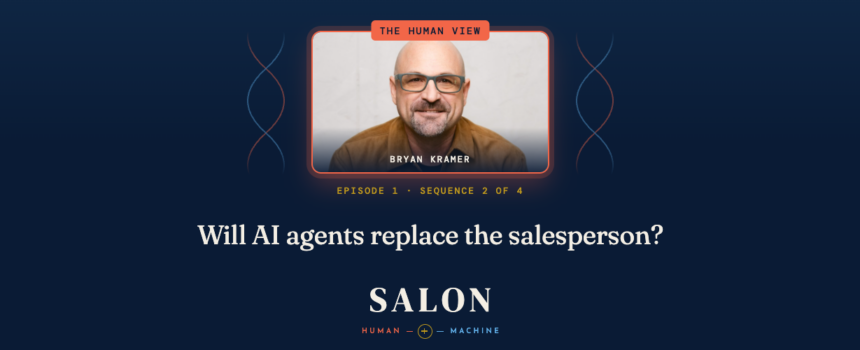
Bryan Kramer, President & Co-Owner, PureMatter
| Episode | Salon #1 · Sequence 2 of 4: The Human View |
| Debate Question | Will AI agents replace the salesperson? |
| Speaker | Bryan Kramer, President & Co-Owner, PureMatter (human view) |
| Website | bryankramer.com |
| Full Episode | Watch all Salon episodes | Listen on the Sales POP! Podcast Page |
The Human View
In the second part of Salon #1, the Sales POP! debate show, Bryan Kramer, President and Co-Owner of PureMatter, made the case for the human. He started by saying he is not against AI. He runs more than 100 agents and sub-agents every day, and he agreed with much of what the machine side said: “we should let the machine find the leads, do the research, or write the follow-ups.” People should edit that work before it goes out, but if AI gets them 80 to 90% of the way, it is helping.
His line between the two sides: “AI didn’t make selling harder; I think it just made fake selling impossible.” Inboxes full of spam and pushy LinkedIn messages, he said, are turning buyers off. He then named three things that are left for humans to do.
1. The buyer arrives informed
Kramer asked listeners to “picture the buyer the night before your first call.” That buyer asks ChatGPT, Claude or Grok to compare you with your three competitors and, in his words, is “ready in 10 minutes.” The rep who reads the deck adds nothing. The job is no longer to explain why the buyer needs the product, but why they should choose you. Kramer cited Gartner: “In 2026, Gartner said that 67% of B2B buyers would rather skip the salesperson.” He added that, according to Gartner, “69% would go back to a human to check what the AI told them because we don’t trust it yet.” His conclusion: “The AI gave them answers, but the AI did not give them confidence in buying.” AI does not know the buyer’s boss, their budget fight or what happens if the project fails. Explaining “what it means for you” is now the rep’s job.
2. A committee needs an honest voice
“It’s rarely one buyer; it’s usually a room of people,” Kramer said, and people in the room often agree with each other because they lack the context. To make his point, he described a conformity experiment by psychologist Solomon Asch. In his account, “75% of the real people ended up changing their answer once that person shifted their answer.” For Kramer, the honest voice in the room is the salesperson, who hears customer pain points first. “We have to listen to the salesperson more now than ever.” An agent, he added, “has no skin in the game.”
3. Someone has to own the mistake
“When it goes wrong, someone’s got to own it,” Kramer said. He told the story of Jake Moffatt, who asked an Air Canada chatbot about bereavement fares after his grandmother died in November 2022. The bot told him to book at full price and claim the discount within 90 days. Air Canada later refused, because the real policy did not allow it. Moffatt took the airline to small claims court in British Columbia and won: the ruling made Air Canada responsible for everything on its website, the bot included. The claim was about $800. “Picture a seven-figure deal going wrong,” Kramer said.
His answer to the debate question: “the salesperson’s job is to help people decide through real connection and tell the truth in the room, because the AI has no skin in the game.”
Pull Quotes
AI didn’t make selling harder; I think it just made fake selling impossible.
— Bryan Kramer
The AI gave them answers, but the AI did not give them confidence in buying.
— Bryan Kramer
An agent has no skin in the game.
— Bryan Kramer
The Human View in Numbers
| Number | Detail |
|---|---|
| 100+ | AI agents and sub-agents Bryan Kramer runs every day |
| 80–90% | How far AI can get on leads, research and follow-ups before a person edits the work (Bryan Kramer) |
| 3 competitors | Rivals a buyer asks AI to compare you against the night before a first call |
| 90 days | Window in which the Air Canada chatbot said the bereavement discount could be claimed |
| About $800 | Amount at stake in the Air Canada chatbot case |
About the Facilitator
Nikolaus Kimla, founder of Sales POP! and CEO of Coevera, leads every Salon debate. Rather than interviewing the speakers, he gives each side room to make its case, then brings the two views together at the end of the episode.
Previously in Salon #1: Eri Georgiev and Rohaan Khan of Sorn AI make the case for the machine.
Next in Salon #1: the two sides question each other in the debate.
Related Resources
- Book Bryan Kramer for a keynote or coaching session
- All Salon episodes: salespop.net/media/salon/
- Sales POP! Podcast: salespop.net/media/podcast/
- Coevera: coevera.com







Comments