




Sales Operations and Revenue Operations are often conflated, but they represent fundamentally different operating models. Sales Ops is functional—it optimizes for the sales team’s productivity and execution. RevOps is transformational—it aligns the entire customer lifecycle around shared revenue goals. Understanding the difference is critical for sales leaders deciding how to organize their operations.
Sales Operations Defined
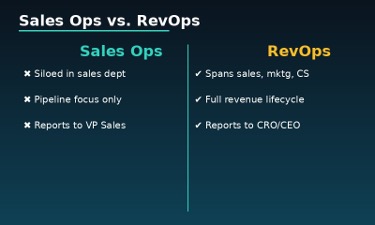
Sales Operations (Sales Ops) is the discipline of enabling the sales organization through process design, technology management, and analytics. Traditional Sales Ops sits within the sales organization, reporting to the Chief Sales Officer or VP of Sales. Their mandate is singular: to maximize sales team productivity and revenue.
Sales Ops responsibilities include CRM administration and data management, sales process design and methodology, compensation plan design and management, territory planning and account assignment, forecasting and pipeline analytics, and sales tool stack management. Sales Ops teams are experts in making the sales machine run efficiently—training reps on the CRM, designing optimal territory structures, creating compensation plans that motivate desired behaviors, and analyzing why some reps outperform others.
Sales Ops reports directly to sales leadership because its entire focus is sales excellence. This positioning creates organizational clarity and allows Sales Ops to move quickly. When the VP of Sales decides to change the sales methodology or restructure territories, Sales Ops executes the changes. Sales Ops has deep knowledge of sales challenges and speaks the language of sales leaders.
Revenue Operations Defined
Revenue Operations (RevOps) is the discipline of aligning all functions contributing to revenue around shared metrics, data, and processes. RevOps typically reports to the Chief Revenue Officer, CEO, or Chief Business Officer rather than directly to sales. This positioning is critical—it creates peer relationships with sales, marketing, and customer success leadership.
RevOps responsibilities extend far beyond sales. They include designing the customer lifecycle from the first marketing touch through post-sale expansion, creating a unified data infrastructure that serves all functions, establishing shared KPIs that optimize overall revenue rather than individual-function metrics, and designing handoff processes between marketing and sales, and between sales and customer success. RevOps operates across organizational boundaries, requiring different perspectives and relationships.
RevOps maintains depth in sales operations capabilities but adds breadth across the entire revenue cycle. RevOps leaders must understand demand generation, customer acquisition, customer retention, and expansion. They make tradeoff decisions that sometimes benefit one function at the expense of another (e.g., higher-quality leads from marketing even if volume decreases) because they’re optimizing for overall revenue, not individual function metrics.
Side-by-Side Comparison
| Dimension | Sales Operations | Revenue Operations |
| Scope | Sales team productivity | Complete customer lifecycle |
| Reports to | VP Sales / Chief Sales Officer | CRO / CEO / Chief Business Officer |
| Primary Focus | Sales team enablement and efficiency | Revenue optimization across all touchpoints |
| Stakeholders | Sales team, sales leadership | Sales, marketing, CS, finance leadership |
| Key Metrics | Win rate, quota attainment, rep productivity | CAC, LTV, pipeline generation, retention rate |
When to Evolve from Sales Ops to RevOps
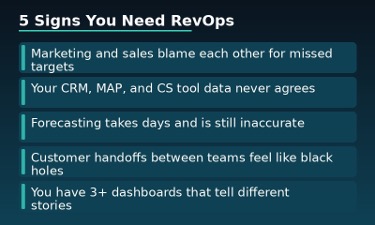
Not every organization should immediately establish RevOps. The transition from Sales Ops to RevOps is appropriate when your business hits specific inflection points. Here are five signs your organization should evolve to a RevOps structure:
Sign 1: Marketing and Sales Misalignment
If marketing and sales frequently argue about lead quality, volume, and timing, your organization needs RevOps. Sales Ops can’t fix this problem because they don’t control marketing. RevOps brings both functions under unified leadership, enabling shared KPIs and aligned incentives. When marketing and sales optimize for the same outcomes, lead quality improves dramatically.
Sign 2: Expansion Revenue Isn’t Growing Proportionally
If new business sales grow by 50% while expansion revenue grows by only 10%, it indicates a lack of coordination between sales and customer success. Sales Ops focuses on new business and has limited visibility into customer success. RevOps creates accountability for the complete customer lifecycle, enabling expansion planning and execution.
Sign 3: Forecast Accuracy Is Poor
If your forecast regularly misses by 15%+, the issue often isn’t sales data—it’s incomplete data across marketing, customer success, and sales. Sales Ops sees only pipeline, not early-stage demand or expansion opportunities. RevOps integrates all data sources, enabling accurate prediction of total revenue.
Sign 4: Customer Acquisition Cost Is Rising While Lifetime Value Is Stagnant
This pattern indicates operational friction across the customer lifecycle. Better Sales Ops might slightly improve close rates, but real improvement requires RevOps-level coordination across demand generation, sales efficiency, and customer retention.
Sign 5: Revenue Growth Is Decelerating Despite No Market Changes
When your growth rate slows, but the market remains strong, the issue is usually operational. Different functions are optimizing locally rather than globally. RevOps realigns the organization around overall revenue growth rather than optimizing individual functions.
Making the Transition
Transitioning from Sales Ops to RevOps requires deliberate organizational change. Start by educating leadership on the RevOps model and its impact on growth companies. Share case studies from similar companies that accelerated growth through RevOps. Build a business case that shows how improved cross-functional alignment would address your specific challenges.
Next, identify your RevOps leader. This person must have deep Sales Ops expertise but also be respected by marketing and customer success leaders. They need to understand all three functions and bridge organizational silos. This hire is critical—the wrong RevOps leader creates more friction than improvement.
Once your RevOps leader is in place, work together to map the current customer journey and identify friction points at handoffs. Design new processes that eliminate silos. Establish shared KPIs that reward cross-functional collaboration. Implement systems and tools that integrate data across functions. This transformation typically takes 6-12 months, but the payoff is substantial.
Learning More
Revenue Operations is becoming the standard operating model at high-growth companies. If your organization shows any of the five signs listed above, it’s time to explore RevOps. Learn more by reading our complete guide to Revenue Operations or discover how to build a RevOps strategy from scratch. Start your transformation today.






Comments