



Sales prospecting remains the most time-consuming activity in the sales process. On average, sales reps spend 22% of their week on prospecting—yet 70% of cold outreach never generates a response. AI transforms this equation by automating routine prospecting tasks and focusing human effort on high-probability opportunities. In this step-by-step tutorial, you’ll learn exactly how to implement AI prospecting workflows that dramatically improve response rates and conversion.
Step 1: Define Your ICP with AI Analysis
Before reaching out to anyone, you must know exactly who you’re trying to reach. Your Ideal Customer Profile (ICP) defines the company characteristics, job titles, firmographics, and challenges that make a prospect “ideal.” The traditional ICP definition relied on manual analysis of your existing customer base. AI accelerates this dramatically.
Use your CRM data to train an AI model on your existing customers and past closed deals. Analyze common characteristics: What’s the average company size? Revenue? Industry? Location? How many employees are in sales? What’s their technology stack? AI clustering algorithms automatically identify patterns, creating a data-driven ICP rather than relying on guesses.
Tools like 6sense and Demandbase include ICP analysis modules that automatically analyze your customer base and identify patterns. They segment your audience by company characteristics and buying behavior, revealing which customer profiles have the highest lifetime value and fastest sales cycles. This data-driven approach replaces sales manager intuition with statistical insight.
Document your ICP clearly: specific revenue ranges, industries, decision-makers’ job titles, technology stack indicators, and pain points. This ICP becomes your filtering lens for every prospecting decision. Any prospect outside your ICP receives different treatment from those who match your profile.
Step 2: Use Intent Data to Find Active Buyers
Not all prospects are created equal. At any given moment, only 3-5% of your addressable market is actively researching solutions like yours. Reaching out to someone in buying mode is exponentially more effective than cold outreach to a random prospect. Intent data reveals which companies are actively researching your solution.
Intent data sources include monitoring search queries, tracking website content consumption, and integrating third-party data. When you see a prospective company researching keywords related to your solution—”CRM for sales teams,” “sales pipeline forecasting,” “revenue operations tools”—that signals buying intent. Platforms like 6sense, Demandbase, and Terminus capture this intent data across the web.
The advantage is timing. Traditional cold outreach might reach a prospect 6 months before they’re ready to buy. Intent-based prospecting reaches them at different stages of their buying journey. Studies show that reaching out to prospects in active buying mode increases conversion rates by 3-5x compared to random cold outreach.
Implement intent data by connecting a platform to your CRM. Each morning, your sales team reviews a priority list of accounts showing buying signals for your solution. Rather than randomly selecting from a list of 100,000 potential prospects, your team focuses on the 50-100 accounts currently under research. This focused approach dramatically improves productivity.
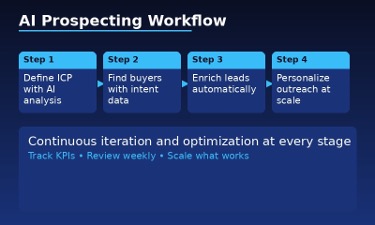
Step 3: Auto-Enrich Leads with Firmographic Data
Prospect data degrades constantly. Email addresses change, phone numbers disconnect, titles shift, and company information becomes outdated. Rather than manually researching each prospect on LinkedIn, use AI-powered data enrichment platforms to automatically append complete, verified contact information and firmographic data to your CRM.
Tools like Apollo.io, Hunter.io, and RocketReach automatically find and verify email addresses for prospects at your target accounts. When paired with company data platforms, they provide detailed firmographic information, including exact employee count, revenue, funding status, technology stack, company growth rate, and org structure.
This enrichment enables intelligent list segmentation. Instead of sending the same message to all prospects at an account, segment by title (targeting multiple stakeholders differently), by seniority level (crafting messaging appropriate to each level), or by department (sales leaders vs. finance vs. operations). The enriched data transforms bulk outreach into targeted, multi-touch campaigns.
Enhance your data by connecting a data platform to your CRM. Configure rules: when a new lead enters your CRM, automatically enrich with verified email, phone, title, company data, and technology stack. This happens in minutes, ensuring your team works with complete, accurate prospect data.
Step 4: Generate Personalized Outreach at Scale
Generic cold emails fail. Prospects receive hundreds of emails daily and immediately delete obviously templated messages. AI changes this by enabling true personalization at scale. Rather than writing individual messages to each prospect, AI generates unique, personalized emails based on firmographic data, company information, and prospect context.
AI personalization goes beyond inserting names. Modern AI models analyze prospect company information and generate custom opening lines: “I noticed Acme just raised a Series B—congrats! I wanted to share how similar fast-growing SaaS companies use [solution] to improve sales productivity.” This approach feels personal because it references specific, relevant information about the prospect.
Implement by connecting an AI email assistant, such as Outreach, Salesloft, or Conversica, to your prospect list. Define your value proposition, key messaging pillars, and call to action. The AI system generates unique emails for each prospect that reference their company, industry, recent news, and relevant pain points. A/B testing automatically identifies subject lines and openings that resonate.
The impact is dramatic. Personalized outreach from AI systems achieves 35-45% higher response rates than generic templates. When combined with intent-based targeting, response rates exceed 50% because you’re reaching the right person with the right message at exactly the right time.
Step 5: Score, Prioritize, and Iterate
As responses arrive, prioritize based on the likelihood of closing. AI lead scoring uses multiple signals—response timing, message content, engagement level, company characteristics, and account intent—to rank prospects by conversion probability. Rather than your sales team chasing any response, they focus on conversations with the highest probability of becoming customers.
Configure your CRM scoring to weight multiple factors: company size and fit with your ICP; engagement velocity (how quickly they responded and how engaged they are); intent signals (are they researching related topics); and competitor presence (are they currently using a competitor solution). These combined signals predict the probability of being close far better than any single metric.
Finally, create feedback loops to continuously improve your prospecting machine. Track which ICPs convert fastest. Which intent signals predict closed deals? Which outreach messages generate the highest response rates? Feed this data back into your prospecting workflow to refine your targeting, messaging, and sequencing over time. After 2-3 months of optimization, most organizations achieve 2-3x improvement in prospecting efficiency.
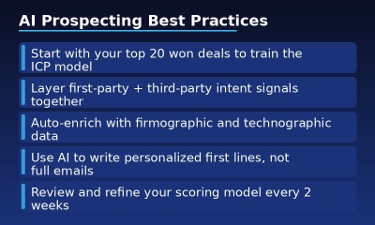
Implementation Checklist
- Define your ICP based on analysis of your best customers
- Connect the intent data source to identify active buying signals
- Implement data enrichment to append complete contact and company information
- Deploy AI-powered email to generate personalized outreach at scale
- Configure lead scoring to prioritize the highest-probability opportunities
- Create feedback loops to continuously optimize based on results
Getting Started
AI prospecting requires several tools working in concert: lead generation, data enrichment, email automation, and lead scoring. Implementing these individually takes months and creates integration challenges. Consider a unified platform like Coevera that incorporates lead scoring, opportunity management, and AI insights into a single system.
Ready to transform your prospecting? Download our free prospecting checklist to implement these strategies step-by-step, and start reaching the right prospects with the right message at the right time.




Comments