



Let’s be honest: most sales forecasts are wildly inaccurate.
Despite sophisticated CRM systems and endless pipeline reviews, fewer than 30% of sales leaders actually trust their forecasts. The average forecast error? A staggering 15-20%.
The problem isn’t that sales teams aren’t trying. The problem is that most forecasting failures stem from broken fundamentals—poor CRM data, misaligned incentives, and methods that prioritize speed over accuracy.
Here’s what actually works in 2026.
The Real Reason Forecasts Fail
Most organizations obsess over forecasting methodology while ignoring the foundation that determines accuracy: CRM data quality.
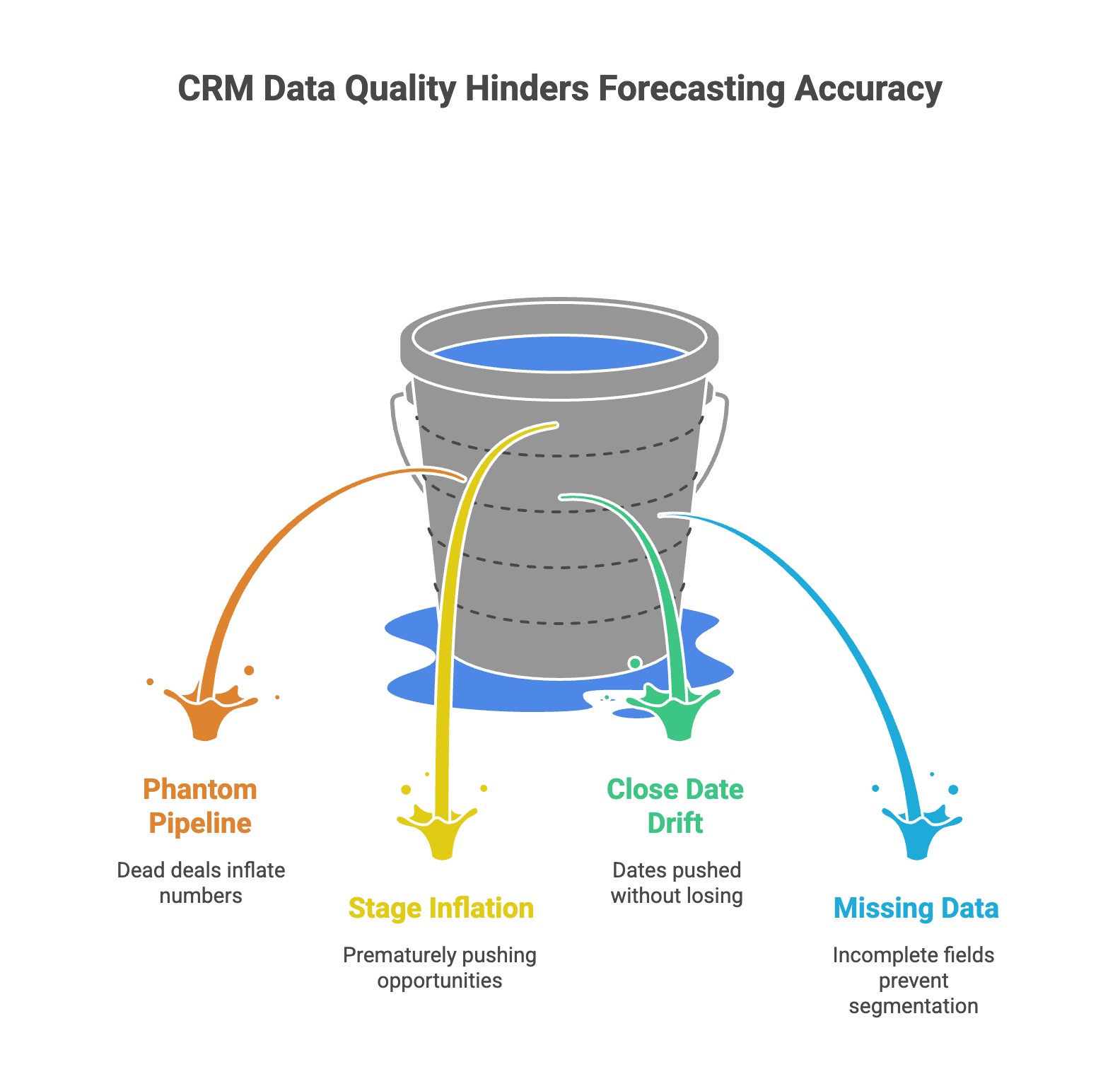
Your forecasting method doesn’t matter if your CRM is filled with:
- Phantom pipeline: Deals that died months ago still inflating your numbers
- Stage inflation: Reps pushing opportunities forward prematurely to look productive
- Close date drift: Continuously pushing dates without ever marking deals as lost
- Missing data: Incomplete fields preventing accurate segmentation
The uncomfortable truth? Your CRM data structure matters more than your forecasting formula.
The 5 Forecasting Methods That Actually Work
1. Opportunity Stage Forecasting
Assign probability weights to each pipeline stage based on your actual historical conversion rates—not arbitrary round numbers.
The mistake: Using default probabilities (20%, 50%, 75%) that your CRM vendor set.
The fix: Calculate your actual conversion rate by stage over the last 12 months. If only 35% of deals in “Proposal” stage close, your probability should be 35%, not 50%.
2. Historical Trend Analysis
Project future revenue based on growth patterns, accounting for seasonality.
When it works: Mature businesses with 2+ years of clean data and stable market conditions.
When it breaks: During major business model shifts, market disruptions, or GTM changes.
3. Sales Cycle Length Forecasting
Use average time-to-close to predict when current opportunities will convert.
Critical insight: Your sales cycle isn’t one number. Segment by deal size, source, and customer type. A $10K SMB deal and $500K enterprise deal have completely different cycles.
4. Rep Intuitive Forecasting
Sales reps assess each deal and provide their best judgment.
The problem: Without accountability, this can degenerate into sandbagging (under-forecasting to beat expectations) or into optimism (over-forecasting to appear busy).
The solution: Track and publish forecast accuracy by rep. Reward accuracy, not just exceeding forecast.
5. AI/ML Forecasting
Machine learning analyzes dozens of variables to generate probability scores.
Requirements: 1,000+ closed opportunities, clean data, and someone who understands what the model is actually predicting.
Warning: Don’t treat AI as a magic black box. If you can’t explain which variables drive predictions, you can’t improve accuracy.

The Six Deadly Forecasting Sins
Sin #1: The Sandbagging Problem
Reps consistently forecast 60-70% of what they actually close, making themselves look heroic when they “beat” their number.
Why it happens: Comp plans and recognition systems that reward exceeding forecast rather than accuracy.
The fix: Recognize reps who forecast within ±5% of actual, not those who sandbag by 30%.
Sin #2: The Commitment Gap
Sales commits one number to leadership, and leadership commits a different (higher) number to the board.
The fix: Align on single forecast definitions. If using multiple categories (pipeline, best case, commit), establish clear relationships between them based on historical data.
Sin #3: Recency Bias
Last week’s big win creates overconfidence. Last week’s loss creates pessimism.
The fix: Use quantitative methods that consider 12+ months of data, not just recent gut feelings.
Sin #4: False Precision
Reporting forecasts as $1,847,392 when your actual accuracy is ±15%.
The fix: Present forecasts as ranges with confidence intervals, such as “$1.8M – $2.1M at 80% confidence.”
Sin #5: The New Rep Blind Spot
Treating brand new reps the same as tenured ones in forecasting models.
The fix: Segment forecasts by rep tenure. Apply different probability weights for reps in their first 90 days versus fully ramped reps.
Sin #6: Revenue Without Mix
Hitting the right total revenue but missing product mix, creating operational chaos.
The fix: Forecast and track accuracy at the product line level when mix matters for delivery or operations.
Your Quarterly Forecast Health Check
Use this quick checklist every quarter:
Data Foundation:
- Stage probabilities match actual 12-month conversion rates
- Required fields (close date, amount, stage) are 95%+ complete
- Stale opportunities (30+ days past typical cycle) are flagged automatically
- Historical win/loss data retained for 24+ months
Process Discipline:
- Forecast definitions are documented and understood
- Forecast vs. actual is reviewed in every 1:1
- Accuracy metrics are visible in dashboards
- Incentives reward accuracy, not optimism
Accuracy Measurement:
- Accuracy tracked over 6+ quarters to identify trends
- Root cause analysis for >10% forecast misses
- Accuracy measured by rep, segment, and product
- Forecast accuracy targets exist (±10% for mature orgs)
What Should Be in Your CRM for Accurate Forecasting
Every opportunity needs these minimum fields:
Required:
- Opportunity name, account, close date, amount
- Current stage
- Probability % (auto-populated, rep can override)
- Forecast category (Pipeline / Best Case / Commit)
Recommended:
- Source (Inbound / Outbound / Partner)
- Deal type (New logo / Expansion / Renewal)
- Product category
- Close date change history
- Stage progression timestamps
Advanced (for complex sales):
- Economic buyer identified (Y/N)
- Champion identified (Y/N)
- Budget confirmed (Y/N)
- Decision criteria defined (Y/N)
Choosing Forecasting Software in 2026
Most CRMs include basic forecasting, but capability differences matter:
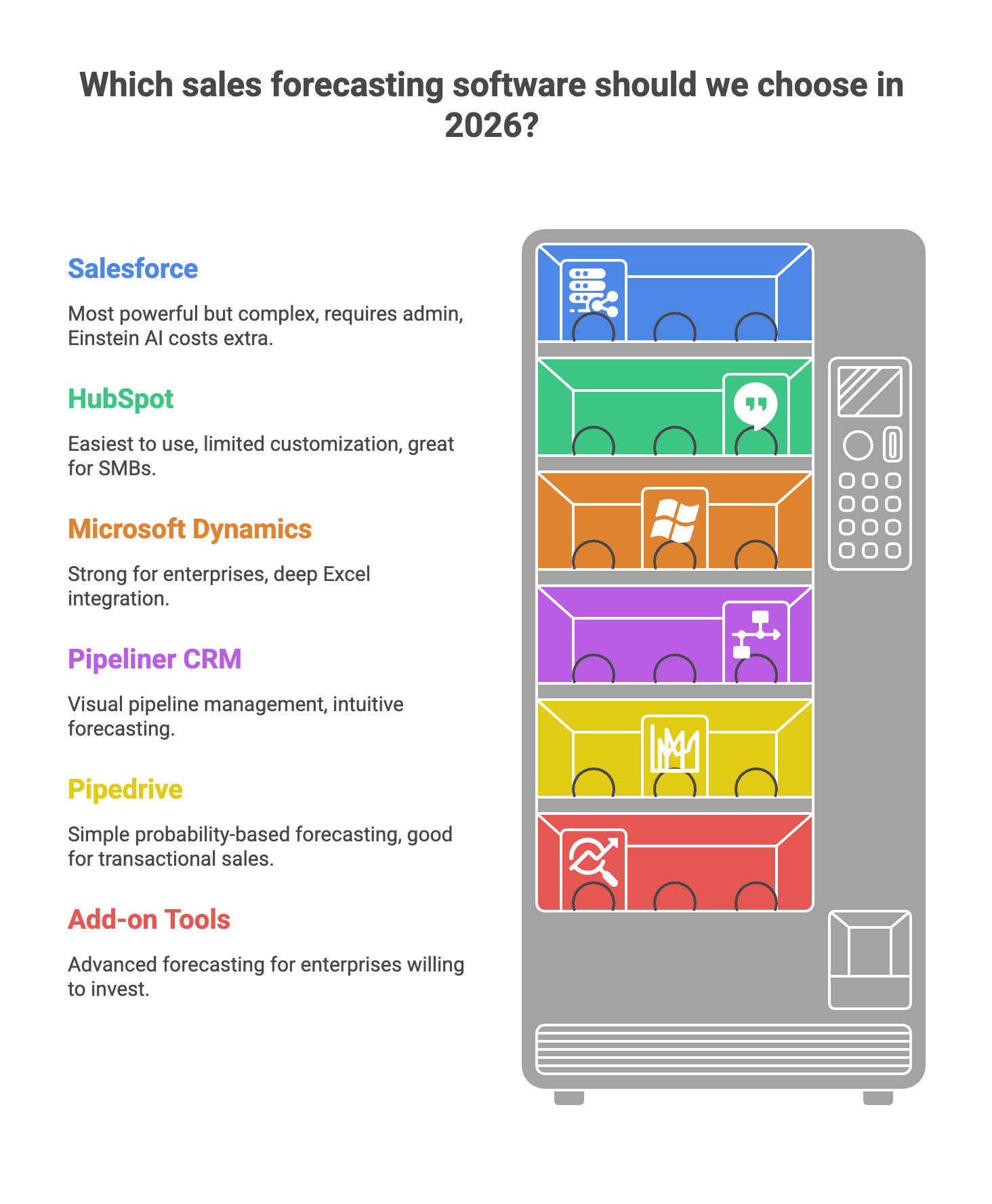
- Salesforce: Most powerful but complex. Requires a dedicated admin. Einstein AI costs extra.
- HubSpot: Easiest to use, but limited customization. Great for SMBs who prioritize simplicity.
- Microsoft Dynamics: Strong for enterprises already in the Microsoft ecosystem. Deep Excel integration.
- Coevera: Visual pipeline management with intuitive forecasting. Powerful without enterprise complexity.
- Pipedrive: Simple probability-based forecasting. Good for transactional sales, limited for complex B2B.
- Add-on tools like Clari and Aviso provide advanced forecasting for enterprises willing to invest in specialized platforms.
Must-Have Features:
- Custom probability weighting by stage
- Multiple forecast categories
- Historical forecast vs. actual reporting
- Rep-level accuracy tracking
- Mobile forecast submission
Nice-to-Have:
- Automated weekly forecast snapshots
- Multi-dimensional forecasting (product, region, segment)
- AI-powered probability scoring
- Deal risk alerts
- Scenario modeling

Building a Culture That Actually Forecasts Accurately
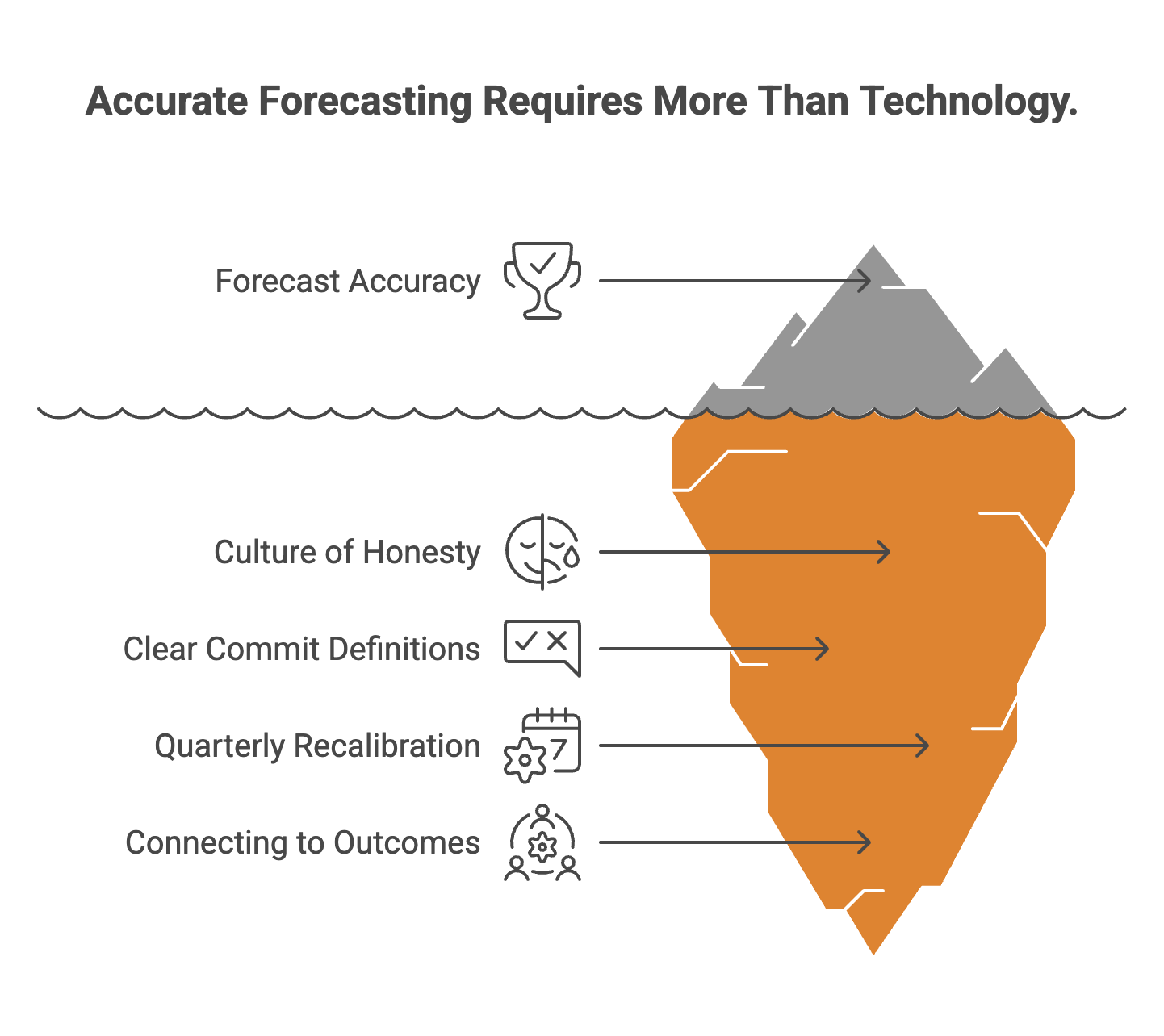
Technology can’t fix a broken culture. Here’s what separates accurate forecasters from chronic over-optimists:
- Make accuracy visible. Create leaderboards showing forecast accuracy, not just quota attainment. Celebrate the rep who forecasted within 2% of the target, even if the rep who hit 120% gets the credit.
- Separate forecast reviews from performance management. If reps fear punishment for honest assessments, they’ll game the system every time.
- Define “commit” clearly. Document exactly what belongs in each forecast category. Ambiguity creates inconsistency.
- Recalibrate quarterly. Markets change. Sales cycles evolve. Last year’s probability weights may need adjustment.
- Connect forecasting to outcomes. Show how forecast accuracy enables better hiring decisions, marketing budget allocation, and capacity planning. When it feels like bureaucratic overhead, discipline evaporates.
The Simple Truth About Forecasting
Perfect forecasts don’t exist. The goal isn’t certainty—it’s systematic improvement. Organizations that treat forecasting as a core competency invest in data quality, calibrate methods against performance, measure relentlessly, and reward honest assessment over optimistic projections. Start small: Pick one improvement from this article. Track accuracy for one quarter. The compound returns of even modest improvements are substantial.
Your competitors are already doing this. The question is whether you’ll catch up before the gap becomes permanent.





Comments