



People don’t come to a website to admire the words. They come to decide. They want to know if the offer fits, if the team understands their problem, and what happens next. Web copy shapes that decision long before a sales call starts.
Most leads need around five points of interaction before they convert. Those touches add up fast when copy stays vague or cautious.
Strong web copy reduces that drag. It sets context early, answers the questions buyers usually save for later, and makes the next step feel reasonable instead of risky. Fewer interactions mean less hesitation and cleaner handoffs to sales.
With that in mind, we’ll look at how sales-ready web copy supports each stage of the funnel. We’ll focus on how structure, language, and intent work together to guide users from interest to action.
Let’s examine the anatomy of copy that truly works.
Storytelling
Storytelling plays a clear role at the top of the funnel. At this stage, visitors decide whether they trust you enough to keep reading.
Facts matter, but context builds confidence. When people understand who you are and why you do the work, they stay longer and move into consideration with fewer doubts.
This works because buying decisions start with emotional safety. Readers want to feel understood before they evaluate details. A strong story creates momentum by answering unspoken questions early: Who is behind this business? Can I trust their judgment?
When those answers appear upfront, visitors don’t need extra reassurance later.
Doing this well requires restraint and focus:
- Start with background details that explain your point of view or experience.
- Tie personal facts to the problem you solve.
- Keep the spotlight on relevance, not personality for its own sake.
- Short sections work best, placed early on key pages like the homepage or About page.
- Write in plain language.
- Avoid exaggeration.
- Let the story support credibility, not replace it.
To see this in action, we’ll explore a real estate agent’s website. John Campbell works in residential real estate on Hilton Head Island, a market where local knowledge shapes buying decisions.
His homepage leads with personal context that signals trust right away. He opens with “7th Generation Gullah Native to HHI,” which grounds his expertise in lived experience. Just below, a short “Meet John” section explains his family’s long history on the island and connects that background to his career in real estate.
The copy feels direct and human. It helps visitors understand why he knows the area so well and why that matters to them. That clarity moves readers from curiosity to serious consideration without extra steps.
Persuasive CTA Labels
CTA labels matter most in the middle of the funnel, when visitors weigh effort against outcome. At this point, users understand the offer but still hesitate to act. A vague button forces them to guess what happens next. A clear, specific label reduces that friction and nudges them toward a decision.
People assess risk before they click. Labels that describe a concrete outcome feel safer and more useful.
Data supports this behavior. CTAs that spell out the value instead of using generic terms like “Submit” or “Contact Us” can increase conversion rates by up to 161%. The lift comes from clarity, not pressure. Users know what they’ll get and why it’s worth their time.
Execution stays simple:
- Start by matching the CTA to the user’s intent at that funnel stage.
- Early actions should promise insight, not commitment.
- Use first-person language when it fits, since it mirrors the reader’s internal decision.
- Keep labels short and specific.
- Focus on outcomes, not actions. “Download,” “Book,” or “Request” matter less than what follows them.
- Every primary CTA should answer one question clearly: What value do I receive after clicking?
R.E. Cost Seg is a company specializing in cost segregation services for real estate owners, a technical field where buyers want clarity fast.
On their homepage, the main CTA buttons read “Get My Free Proposal” and “Calculate My Savings.” Both labels speak directly to the audience’s goal: understanding financial upside with low risk. The language removes uncertainty and frames the action as helpful, not demanding.
This helps visitors move from evaluation to action without needing extra explanation or reassurance.

Source: recostseg.com
Customer-Specific Terminology and Segmentation
This strategy supports the consideration stage of the funnel, where visitors decide whether a solution fits their exact situation. Generic copy slows that decision. When people have to translate your message to their own context, they hesitate or leave.
Segmented pages remove that extra work and help users see themselves in the offer right away.
Buyers listen for familiar language. Industry terms, daily frustrations, and common scenarios signal relevance. When copy reflects how a specific group talks and thinks, trust builds faster. Visitors move from interest to evaluation with fewer doubts because the page feels designed for them, not everyone.
Doing this well starts with clear audience definitions:
- Group customers by role, industry, or primary problem, not by broad demographics.
- Build dedicated landing pages for each segment instead of squeezing everything into one page.
- Use terminology your customers use in real conversations.
- Address their typical challenges, objections, and goals directly.
- Keep the structure consistent across pages so performance stays easy to measure, but adapt examples, benefits, and CTAs to match each group’s priorities.
- Avoid overloading pages with features.
- Focus on outcomes that matter to that segment.
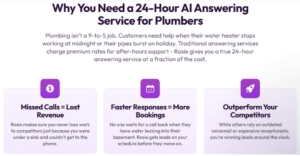
Rosie shows this approach in practice. The company provides an AI answering service designed for small and service-based businesses. Instead of one generic page, Rosie creates dedicated landing pages for each industry they serve.
Their service page for plumbers speaks directly to that audience. It explains why missed calls cost jobs, how the service handles after-hours requests, and what plumbers gain in time and peace of mind. The language, examples, and use cases match real plumbing workflows.
That specificity helps visitors quickly decide the service fits their needs and move closer to conversion.
Source: heyrosie.com
Customer-Focused Value Propositions
At the evaluation stage of the funnel, visitors compare options and decide which one feels right. At this point, they don’t need a lesson on how a product works. They want to know how life looks after they use it.
Headings that reflect the customer’s experience help them picture that outcome faster.
This approach works because readers scan first. Headlines and sub-headings shape their understanding before they read a single paragraph. When those lines speak in product terms, users must translate the benefits themselves. When they speak in customer terms, the value lands immediately.
That keeps visitors engaged and moves them closer to action with less effort.
To craft these propositions:
- Write headings from the reader’s point of view.
- Focus on results, relief, progress, or confidence.
- Use language customers already use when describing their goals.
- Skip internal terms, features, or processes in primary headings.
- Save those details for supporting copy further down the page.
- Each heading should answer a simple question: What changes for the customer?
- Keep phrasing direct and concrete.
- Avoid hype.
- Make sure every major section reinforces the same core outcome so the message stays consistent as users scroll.
Socialplug applies this clearly. The brand operates a marketplace for social media growth, offering followers, likes, views, and comments across platforms.
On their homepage, the main value propositions reflect the customer’s goal, not the mechanics behind the service. A headline like “Buy Followers, Likes, Subscribers, Views & Grow Exponentially” speaks directly to what users want to achieve.
It doesn’t explain how the service works or what tools it uses. It simply frames the offer in terms of visible growth and momentum.
That strategy helps visitors quickly decide whether the service aligns with their goals and keeps them moving through the funnel without friction.
A Problem–Solution Narrative
This approach supports the transition from awareness to evaluation. Visitors arrive with a clear problem in mind, even if they don’t fully name it yet. When copy reflects that pain right away, people feel understood.
That recognition keeps them engaged long enough to consider a solution.
Clarity reduces doubt. Buyers want confirmation that their issue is real, common, and solvable. When a page clearly states the problem and follows with a relevant solution, it removes guesswork. Users don’t have to connect the dots themselves. The product earns attention by addressing what already feels urgent.
To implement this:
- Name the problem in the customer’s words.
- Focus on the consequences they deal with today, not abstract frustrations.
- Keep the problem statement tight and specific.
- Then introduce the solution as a direct response, not a pitch.
- Explain how it removes friction, risk, or loss.
- Break the narrative into short sections so it’s easy to scan.
- Reinforce the connection with examples, FAQs, or short educational resources.
- Avoid listing features too early.
- Tie everything back to resolving the original issue so the story stays coherent.
A great example here is Uproas, a company offering premium agency ad accounts for platforms like TikTok, Facebook, Instagram, and Google.
They serve advertisers who struggle with account limits, bans, or scaling issues. Across their site, Uproas publishes resources that speak directly to these challenges. Their Benefits section includes blog content focused on common social advertising problems, such as account instability or restricted spend. Each piece frames the issue first, then explains how their service addresses it.
This structure helps visitors recognize their own situation and see Uproas as a practical solution, moving them deeper into the funnel with confidence.
Trust-Building Social Proof
Social proof plays a critical role near the decision stage of the funnel. At this point, visitors understand the offer and see the potential value, but they want reassurance before they commit.
This is where your voice matters less than your customers’ experiences.
This strategy is effective because people trust peers more than brands. Around 45% of customers say they trust advertisements, while 92% trust genuine recommendations from other customers.
Those numbers reflect a simple truth: proof from real users reduces perceived risk. When visitors see others succeed with your product, the decision feels safer and more justified.
Using social proof effectively requires selectivity:
- Choose testimonials, reviews, or case studies that reflect specific situations, not vague praise.
- Focus on outcomes, not opinions.
- Numbers, time saved, revenue gained, or errors reduced help ground claims in reality.
- Place social proof close to key decision points, such as near pricing, demos, or primary CTAs.
- Keep snippets short and scannable so readers can grasp the value quickly.
- For longer stories, offer a clear path to learn more without forcing it.
PandaDoc, a platform for creating, approving, and signing documents online, uses this tactic masterfully.
On their homepage, they feature rich snippets pulled from detailed case studies. Each snippet highlights a specific customer, the challenge they faced, and measurable outcomes delivered by the platform, including clear percentages and performance gains.
The format respects the reader’s time. Visitors get enough context to trust the results without reading a full case study upfront. Those who want deeper proof can click through.
This balance supports confident decisions and smooth funnel progression.
Final Thoughts
Sales-ready web copy works when every word has a job. Each section on the page should help visitors move forward with less effort and fewer doubts.
Storytelling builds early trust. Explicit CTAs guide action. Segmentation, value-driven headings, problem–solution framing, and social proof support evaluation and decision-making.
When these elements work together, the funnel feels shorter and more natural. Visitors get answers before they ask. Sales teams spend less time clarifying basics and more time closing aligned prospects.
The result is a copy that respects how people decide and supports them at each step. Consistent, strategic language is your most reliable tool for turning readers into customers.




Comments