



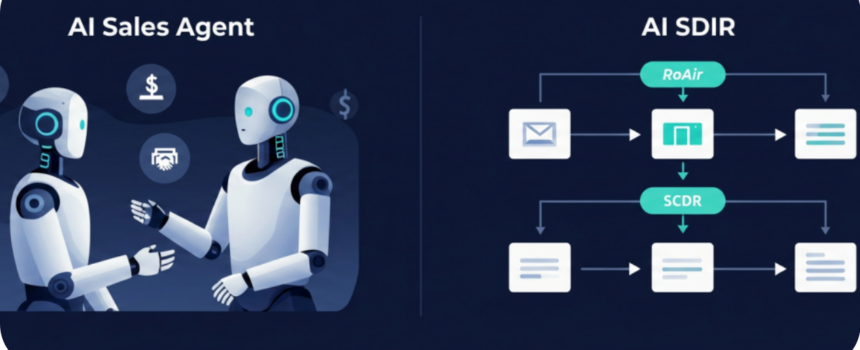
Here is the short version of AI sales agents vs AI SDRs. An AI SDR is a narrow tool that runs outbound prospecting on its own. It finds contacts, researches accounts, drafts and sends sequences, and books meetings. An AI sales agent is broader software that helps across many steps of a deal, not just the top of the funnel. Most teams should start with one, not both, and keep a person in the loop. The right pick depends on where your team loses the most time.
- An AI SDR automates top-of-funnel outbound: research, contact finding, sequences, and meeting booking.
- An AI sales agent works across more of the deal, from prospecting to CRM updates and follow-ups.
- The two overlap at prospecting, which is why the labels get mixed up.
- Neither replaces your team. Steps like pricing and contracts still need a human.
- Match the tool to your bottleneck: pipeline gaps point to an AI SDR, scattered busywork points to an agent.
AI sales agents vs AI SDRs: the plain-English difference
Buyers hear “AI agent,” “AI SDR,” and “AI BDR” and assume they mean the same thing. They do not. The gap is scope. An AI SDR is built for one job: outbound prospecting. A 2026 review of AI SDR tools from salesmotion.io describes this software as automating sales development work, such as researching accounts, finding contacts, and drafting or sending outreach. An AI sales agent is wider. ZoomInfo’s guide to AI sales agents describes an agent as autonomous software that runs sales workflows and adapts based on how a prospect responds. That can include prospecting, but it also stretches into qualification, scheduling, and updating your CRM. Here is a side-by-side view.
| AI SDR | AI sales agent | |
|---|---|---|
| Scope | Top of the funnel (outbound) | Multiple steps across the deal |
| Main jobs | Research, find contacts, draft and send sequences, book meetings | Prospecting, qualification, outreach, scheduling, CRM updates, follow-ups |
| Best for | Filling the pipeline with meetings | Cutting busywork across the whole cycle |
| Human role | Approve targeting and messaging, handle replies | Review high-stakes steps, own strategy and closing |
What an AI SDR actually does
Think of an AI SDR as a tireless prospecting assistant. It handles the top of the funnel so your reps do not have to grind through it by hand. A typical AI SDR will:
- Research target accounts and pull in signals.
- Find the right contacts at those accounts.
- Draft personalized messages.
- Send multi-touch sequences.
- Book meetings on a rep’s calendar.
That is the whole point of the category. It fills your calendar with conversations. It does not run the rest of the deal. Once a meeting is booked, a human takes over.
What an AI sales agent actually does
An AI sales agent reaches further into the sales cycle. Instead of only prospecting, it can chain several steps together and adjust as it goes. Per ZoomInfo, that can include prospect research, personalized outreach, lead qualification through back-and-forth conversation, meeting scheduling, and CRM updates. The key word is “adapts.” A good agent changes its next move based on what the prospect does, rather than following a fixed script. That is also what separates an agent from an old-school chatbot or a simple rule. A chatbot follows a set path. An agent makes a call about the next best action on its own. That freedom is useful. It also means you need guardrails, which we will get to.
Where they overlap (and why the names confuse everyone)
Both tools prospect. Both research accounts, find contacts, and send outreach. An AI SDR is really a focused sales agent pointed at one job. That overlap is why vendors swap the labels around. “AI BDR” adds to the confusion. Some teams use BDR for inbound and SDR for outbound, but most tools treat “AI SDR” and “AI BDR” as the same thing: software that prospects for you. So do not get stuck on the label. Ask what the tool does, step by step, and who stays in control.
What these tools still can’t do
AI in sales is common now. In its 2026 State of Sales report, Salesforce found that 87% of sales organizations use some form of AI, and that 54% of sellers say they have already used AI agents. Nearly 9 in 10 sellers plan to use agents by 2027. So the question is not whether to adopt AI. It is how far to hand over. The limits are real. Autonomous outbound can backfire if you use it to blast volume, because more sends without better targeting can drag down reply rates and inbox placement. Agents fail too. Gartner forecasts that more than 40% of agentic AI projects will be scrapped by the end of 2027. High-stakes moments still need a person. ZoomInfo’s own guidance says actions like custom pricing or contract terms should get human review. That is the theme worth repeating: keep a human in the loop. Let the tool do the repetitive work, and let your team own judgment, strategy, and the close.
How to decide which one you need
Start with your biggest bottleneck. The tool should fix a problem you can name. Choose an AI SDR if:
- Your reps do not have enough meetings.
- Prospecting eats hours that could go to selling.
- Your main gap is top-of-funnel volume.
Choose an AI sales agent if:
- Reps lose time to scattered tasks across the whole cycle.
- CRM updates, research, and follow-ups slip through the cracks.
- You want help past the first meeting, not just before it.
A few teams need both. Most do not, at least not on day one. Pick the one tool that solves your clearest problem. Run a small pilot. Measure meetings, replies, and data quality against a baseline. Keep a person reviewing the output. Then expand once you trust it. Ask yourself one question before you buy: what would my team do with the hours this gives back? If you have a clear answer, you are ready to choose.
Frequently asked questions
Match the tool to the gap. If your team is short on meetings, test an AI SDR. If reps drown in admin across deals, test an agent. Either way, start with a small pilot and keep a person in the loop.




Comments