



Revenue Operations (RevOps) is transforming how high-growth companies operate. Yet the term remains ambiguous, with many sales leaders confused about what RevOps actually encompasses and how it differs from traditional Sales Operations. RevOps is not a rebrand of Sales Ops—it’s a fundamentally different organizational model that aligns every function contributing to revenue around a shared set of metrics, data, and processes.
What Is Revenue Operations?
Revenue Operations is the organizational discipline of aligning Sales, Marketing, Customer Success, and Finance around shared revenue goals through unified processes, data infrastructure, and reporting. Rather than three siloed departments each optimizing their individual metrics, RevOps creates a shared operating system where marketing hands off to sales at precisely the right moment, sales seamlessly transitions customers to Customer Success, and finance can trace every revenue dollar back to its source.
The problem RevOps solves is fragmentation. Historically, Sales Operations optimized for sales productivity. Marketing Operations optimized for lead-generation costs. Customer Success Operations optimized for retention. Each function was a separate optimization puzzle with different metrics, different technologies, and different priorities. This siloed approach creates massive inefficiencies: marketing generates leads that sales doesn’t follow up on, customers are handed off to Success without proper context, and finance can’t explain why revenue is growing faster or slower than expected.
RevOps emerged in the early 2010s at high-growth companies like Salesforce, HubSpot, and Marketo. These companies needed visibility into the entire customer lifecycle—from first marketing touch to post-sale expansion. Traditional functional silos couldn’t provide this visibility. By creating a unified RevOps organization reporting to the Chief Revenue Officer or CEO, these companies eliminated handoff friction, reduced operational costs, and dramatically accelerated revenue growth. The approach has since become standard practice at leading B2B companies.
The Three Pillars of Revenue Operations
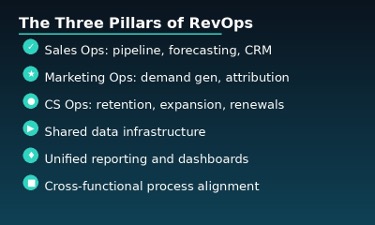
While RevOps is a unified function, it typically consists of three pillars, each addressing a different part of the customer lifecycle:
Sales Operations
Sales Operations manages the tools, processes, and data that make sales teams effective. This includes CRM administration, sales compensation design, territory management, forecasting, and sales process design. Sales Ops ensures reps have clean data, understand the sales methodology, and are compensated in ways that align with company strategy.
Marketing Operations
Marketing Operations manages the demand generation machine. This includes marketing technology stack administration, lead routing and scoring, campaign analytics, and demand generation process design. Marketing Ops ensures marketing generates qualified leads, routes them to sales at the right time, and provides analytics to prove marketing’s contribution to revenue.
Customer Success Operations
Customer Success Operations ensures customers derive value, renew, and expand. This includes implementation processes, customer health scoring, identification of expansion opportunities, and churn prediction. CS Ops creates the conditions for retention and expansion, extending revenue beyond the initial sale.
Why RevOps Matters in 2026
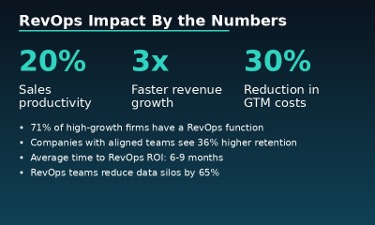
The business impact of RevOps is quantified in rigorous research. Companies with mature RevOps functions outperform peers across every metric. Those with established RevOps practices report 20% improvements in sales productivity, 3x faster revenue growth in new segments, and 30% reductions in customer acquisition costs. These aren’t marginal improvements—they’re the difference between category leaders and laggards.
Consider productivity: Sales reps with RevOps-managed CRM, territories, and compensation spend more time selling and less time administering. Sales leadership has real-time visibility into the pipeline and forecasts, rather than having to manually consolidate data. Sales cycles shorten because marketing passes along better-qualified leads, and sales focuses on opportunity qualification rather than prospecting.
Revenue acceleration compounds. When marketing and sales are aligned, demand generation becomes more efficient. Sales close faster because they receive hot leads at the right moment. Customer Success retains and expands customers more effectively because they understand what success looks like. Each function accelerates the next, creating a virtuous cycle.
Who Owns RevOps?
Organizational structure matters significantly. RevOps can be centralized under a Chief Revenue Officer, distributed across functional leaders, or managed by a dedicated RevOps team. The best approach depends on the company’s maturity and structure. Centralized RevOps reporting to the CRO works well for companies pursuing aggressive growth where cross-functional alignment is critical. Distributed RevOps works better for mature companies with established functional leaders.
The ideal RevOps leader is a T-shaped profile: deep expertise in one area (typically Sales Operations) plus a broad understanding across sales, marketing, customer success, and technology. This person bridges functional silos, speaks the language of each function, and makes trade-off decisions that optimize overall revenue rather than the revenue of individual functions.
Team composition varies based on company size. A small RevOps team might be 3-5 people handling CRM, data, and analytics. Larger organizations might have 15-20 people with specialists in each pillar (Sales Ops, Marketing Ops, CS Ops) plus data engineers, business analysts, and platform architects. The key is ensuring sufficient resources to handle strategy, execution, and ongoing optimization.
Getting Started with RevOps
Building RevOps from scratch requires systematic effort. Step one: Audit your current technology stack and processes. Map out all systems (CRM, marketing automation, customer success tools, etc.), understand how data flows between systems, and identify gaps and redundancies. This audit typically takes 2-4 weeks and exposes where processes break down.
Step two: Identify your highest-priority problem. Rather than trying to overhaul everything, focus on one critical bottleneck. Maybe your issue is sales teams with different processes and compensation models, making it impossible to forecast accurately. Or marketing and sales misalignment resulting in wasted leads. Incomplete customer data is preventing successful planning. Select the problem with the biggest business impact.
Step three: Design your solution. This might involve standardizing CRM, implementing new tools, redesigning processes, or restructuring teams. Design with input from all three functions to ensure your solution addresses root causes rather than symptoms. Allocate 4-8 weeks for design.
Step four: Pilot your changes. Roll out with a pilot group (one sales team, one region, or one customer segment) before full deployment. Measure results against baseline metrics. After 60-90 days, assess what’s working and what needs refinement. Use this data to inform full rollout.
Next Steps
Revenue Operations is not a project—it’s an operational mindset where every function views its work through the lens of overall revenue generation. Companies that embrace this mindset systematically outpace competitors. Learn more about the specific differences between RevOps and traditional Sales Operations, or explore how to build a RevOps strategy from scratch. Start your RevOps journey today by reading our complete RevOps guide.




Comments