



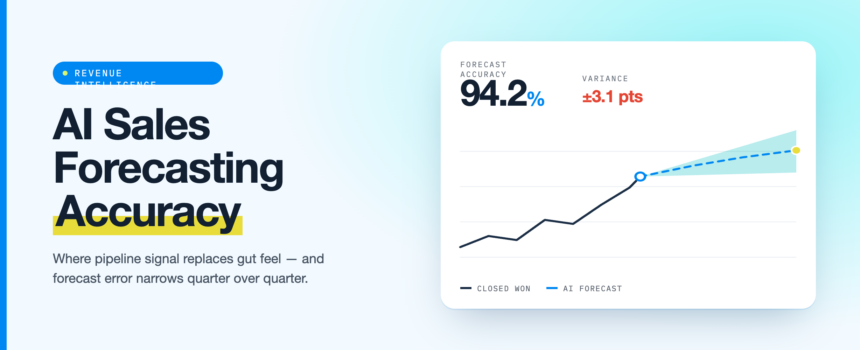
AI sales forecasting can be accurate, but rarely as accurate as the marketing suggests. Accuracy depends less on the software and more on the data you feed it. Give it clean, complete deal records and it can beat a manager’s gut feel. Give it stale, half-filled pipeline and it will hand you a confident number that is still wrong. So when you weigh AI sales forecasting accuracy, judge your CRM data first and the vendor second.
- AI sales forecasting learns from your past deals and CRM activity to predict what will close.
- Accuracy rides on data quality far more than on the model. Garbage in, garbage out.
- Vendors advertise accuracy in the 90s, but very few teams reach 90 percent or better in real life.
- AI usually beats gut-feel forecasting, but only when the pipeline data is clean.
- Treat any AI forecast as a second opinion you check, not a verdict you trust blindly.
What AI sales forecasting actually does
AI sales forecasting uses machine learning to predict which deals will close and when. It studies your closed-won and closed-lost history, then hunts for the same patterns in your open pipeline.
It reads signals a person struggles to track by hand. How long a deal has sat in one stage. How many times the buyer replied. Whether the champion went quiet. How this quarter compares to the last ten.
Out comes a number, usually with a confidence score or a deal health score attached. Many tools also flag which deals look at risk.
That is the useful part. The model never gets tired, never plays favorites, and never talks itself into a happy ending because it wants to hit quota.
So how accurate is it really?
Here is where the marketing and the reality split.
Some AI vendors advertise forecast accuracy in the low to high 90s. A roundup by Oliv lists conversation-driven tools claiming 92 to 98 percent accuracy. Those are vendor claims, measured under vendor conditions, so read them as a ceiling, not a promise.
Now the reality check. Gartner reports that only 7 percent of sales teams achieve forecast accuracy of 90 percent or higher, and that median accuracy lands between 70 and 79 percent. Most teams sit well below the vendor headlines.
Both things can be true at once. A tuned AI model with clean data can be very accurate. Most teams do not have clean data, so most teams do not see those headline numbers. The tool sets the ceiling. Your data sets the floor.
It also helps to ask what “accurate” even means here. A forecast can nail the quarter total and still miss on which deals land. Another can name the right deals but call the timing wrong. So do not chase a single accuracy percentage. Ask whether the tool is right about the things you actually plan around, like this month’s number and your biggest at-risk deals.
AI forecasting versus gut feel
Does AI beat the classic manager roll-up, where reps eyeball each deal and call it? Usually, yes, when the data is there.
Oliv reports that traditional manual forecasting tops out around 60 to 75 percent accuracy. Gut feel carries hidden bias. Reps sandbag so they can look like heroes later. Optimists commit deals that were never real. Managers pattern-match on the last deal that burned them.
AI strips out some of that bias because it weighs every deal by the same rules. It does not get charmed by a smooth rep or spooked by a loud one.
But AI is not magic. It only knows what your CRM tells it. A rep who does not log calls hides the exact signal the model needs. So the AI versus gut question is really a data question in disguise.
Why clean data drives AI sales forecasting accuracy
This is the whole game. Garbage in, garbage out.
Salesforce’s 2026 State of Sales report found that 79 percent of high-performing sales teams prioritize data hygiene, compared with 54 percent of underperformers. The best teams are not just buying smarter tools. They are feeding those tools better data.
Think about what quietly breaks a forecast:
- Deals with no close date, so the model cannot place them in a quarter.
- Stages that do not match reality, like a “verbal commit” that is really a first call.
- Dead deals still marked open, inflating the number.
- Missing activity, so an engaged buyer looks cold.
Every gap becomes a forecast error. The model does not know a field is wrong. It just trusts it.
So before you judge an AI forecast, judge the data underneath it. A clean pipeline is the price of an accurate prediction.
How to sanity-check an AI forecast
Do not trust the number blindly, and do not throw it out either. Put it through a few quick checks before you take it to your boss.
Ask what changed. If the forecast jumped since last week, find the deal or two behind the swing. A good tool shows its work.
Compare it to your own read. Run your normal pipeline review, then hold your gut number next to the AI number. When they agree, you gain confidence. When they clash, you have found the deals worth a closer look.
Check the risky deals by hand. Pull the three biggest deals in the forecast and confirm the close date, the stage, and the last real conversation. Big deals move the number most, so they earn human eyes.
Score the tool over time. Each quarter, compare what the AI predicted against what actually closed. A model that was a few points off last quarter has earned more trust than one you just switched on.
Watch for false confidence. A tidy number with a high confidence score can still be wrong if the data behind it is thin. Confidence is not the same as accuracy.
Used this way, AI forecasting becomes a strong second opinion. It catches deals you missed and questions deals you loved. You still make the call.
Frequently asked questions
Sources
- Oliv, Best AI Sales Forecasting Software
- Gartner, Sales AI (forecast accuracy statistics)
- Salesforce, 2026 State of Sales report




Comments